ultimate-guide · November 6, 2026
The Ultimate Guide to Gear for Giant Breeds
15 min read · Editorial Team
Last Updated: November 6, 2026
Quick Summary
The best gear for giant breeds is built around load ratings, not size labels: a front-clip or dual-clip harness with webbing at least 25mm wide and steel hardware, a collar at least 38mm wide with welded stainless steel D-rings, and a fixed-length lead with a locking clasp. Skip retractables and any product without a stated weight rating, and measure neck, chest girth and back length before you buy.
- Standard pet-aisle gear is built for dogs under 60 pounds and often carries no weight rating at all.
- Measure neck circumference, chest girth and back length, and record each number with the date.
- Skip retractable leads for giant breeds and use a fixed lead of 1.2 to 1.8 metres with a traffic handle.
- Size a crate by measuring nose to tail and adding 10 to 15cm in every direction.
- Replace any gear that has lost its load rating through wear, and inspect everyday items weekly.
Table of Contents
- Why Standard Dog Gear Fails Dogs Over 100 Pounds
- How to Measure and Size Gear for Giant Breeds
- Choosing the Best Gear for Giant Breeds Dog Harness
- Durable Collars for Giant Dogs: What Holds Up Under Load
- Heavy-Duty Leashes for Large Dogs and Real-World Control
- Beds, Crates, and Containment for Extra-Large Dogs
- Bowls, Chews, and Everyday Gear for Giant Breeds
- Giant Breed Hiking and Camping Gear for Rough Terrain
- Mobility, Recovery, and Senior-Dog Equipment
- Choosing Your First Set of Colossal Canine Co. Gear
- Frequently Asked Questions
Why Standard Dog Gear Fails Dogs Over 100 Pounds
A 150-pound Great Dane produces force that most pet-store equipment was never designed to absorb. The best gear for giant breeds starts with a hard truth: standard dog gear fails because it is rated for dogs a fraction of that weight. Webbing thins out, buckles crack, and stitching pulls apart under a single lunge.
Walk through any general pet aisle and you will find collars built for dogs under 60 pounds, sold without any stated weight rating at all. Owners of extra-large dogs learn this the expensive way. A common mistake is assuming "large" on a package means "giant breed ready." It rarely does. American Kennel Club breed weight guidance confirms that breeds like Mastiffs and St. Bernards routinely exceed 120 pounds, well past what mass-market gear is tested for.
That mismatch is the throughline of this guide. Every recommendation below answers one question: will this hold when a strong dog decides to go somewhere you did not plan?
How to Measure and Size Gear for Giant Breeds
Measure twice and size for the dog you will have in six months, not the puppy in front of you today. Giant breeds grow fast, and gear that fits at twelve weeks is useless by six months.
Start with three numbers: neck circumference at the widest point, chest girth just behind the front legs, and back length from collar to tail base. Use a soft tape and add two fingers of slack for comfort. For a growing puppy, measure monthly and buy adjustable equipment rather than fixed sizes. Great Dane Club of America breed information notes these dogs can keep filling out well past their first birthday, so adjustability matters more than any single measurement.
We recommend recording each measurement with the date. It sounds fussy until you are ordering a replacement and cannot remember whether the chest was 38 or 42 inches.
Three measurements cover almost every piece of giant-breed gear you will buy.
| Measurement | Where to measure | Note |
|---|---|---|
| Neck circumference | At the widest point | Add two fingers of slack |
| Chest girth | Just behind the front legs | Record with the date |
| Back length | From collar to tail base | Use a soft tape |
Choosing the Best Gear for Giant Breeds Dog Harness
The best gear for giant breeds dog harness is a front-clip or dual-clip design with wide, padded straps and steel hardware, because it spreads load across the chest instead of the throat. A back-clip harness gives a pulling dog use; a front-clip redirects that force sideways.
Look for webbing at least 25mm wide, a padded chest plate, and metal D-rings rather than plastic. Check the weight rating on the label, and if there is no rating, walk away. For reactive dogs who lunge, a dual-clip harness paired with a training lead gives you a second point of control.
Fit matters as much as build. The harness should sit snug without restricting shoulder movement, and you should be able to slide two fingers under every strap. A loose harness on a 130-pound dog will rub, twist, and eventually fail at the seams.
Durable Collars for Giant Dogs: What Holds Up Under Load
A durable collar for a giant dog is one built from military-grade webbing with solid stainless steel hardware and load-bearing stitching, not a fashion band with a decorative buckle. The buckle is the most-stressed component on any collar, and it is where cheap gear fails first.
Width is your first filter. Collars under 38mm wide concentrate pressure on a thick neck and dig in under load. Look for stainless steel D-rings welded closed, Chicago-style tacks or bar-tacked stitching at stress points, and a quick-release buckle rated for the dog's weight. A quick-release buckle matters on a powerful dog: if the collar catches on fencing or debris, you need to free the dog in one motion, not fight a metal buckle.
Watch out: a quick-release buckle that pops open under a sudden lunge is worse than no quick-release at all. Test the clasp tension before you trust it on a walk.
EXTERNAL_LINK: How to choose a collar that survives a Great Dane breaks down what width, webbing, and hardware ratings actually mean for a 150 lb dog.
Heavy-Duty Leashes for Large Dogs and Real-World Control
Control comes from the leash-handler system, not the leash alone. A heavy-duty leash for a large dog needs a rated clasp, minimal stretch, and a handle you can grip with a second hand when the dog surges.
Skip retractable leads for giant breeds. The thin cord and plastic housing are built for small dogs, and a sudden 150-pound pull can snap the cord or burn your hand. A fixed-length lead of 1.2 to 1.8 metres gives you predictable control, and a traffic handle near the clasp lets you shorten up fast in tight spaces.
Clasp quality decides everything. Look for a stainless steel snap hook with a locking gate, and check that the stitching at both ends is bar-tacked rather than single-stitched. In mud and rain, cheap hardware corrodes and seizes. EXTERNAL_LINK: Leash length and control over 100 pounds compares retractables, fixed leads, and traffic grips for dogs that outweigh their owners.
Beds, Crates, and Containment for Extra-Large Dogs
Containment gear for extra-large dogs is about structural rating, not just size. An oversized dog bed needs a foam density that will not flatten under 150 pounds, and a crate needs a frame rated well above the dog's weight with bar spacing tight enough to prevent a paw or muzzle from catching.
Start with measurements, because "XXL" on a package is not a standard. Measure your dog lying down, nose to tail, and add 10 to 15cm in every direction for a crate. For a bed, measure from nose to tail base and add 15 to 20cm so the dog can stretch out flat rather than curl into a ball. Record chest girth as well if the bed has bolsters or a hood, since a tight bolster can make a correctly sized mattress unusable.
For beds, look for orthopaedic foam with a removable, washable cover, because giant breeds drool, shed, and track in mud. Foam density matters more than thickness: a 10cm slab of low-density foam will compress into a pancake within weeks under a 150-pound dog, while a denser 7 to 10cm base holds its shape. A common pattern is to buy a bed rated by dimensions alone, then discover the fill has collapsed at the hip and shoulder points. Check the cover seams and zipper first, because a washable cover is only useful if it survives the wash.
For crates, check the door latch mechanism first. A determined Mastiff can work a flimsy latch loose. Look for dual-point latches and reinforced corners. Bar spacing should be tight enough that a muzzle or paw cannot pass through, and the frame should be rated well above the dog's weight rather than merely matching it. If your dog is a chewer, line the crate tray with something sturdy rather than a soft mat that becomes a snack.
For exercise pens and gates, the same logic applies. A pen needs a height the dog cannot clear when motivated and a base that will not slide on hard floors. Pressure-mounted gates are a poor fit for giant breeds; look for hardware-mounted gates rated for the dog's weight and anchored into studs. In vehicles, a crate should be secured so it cannot shift in a turn, and the crate itself should be rated for crash containment rather than simple confinement.
Bowls, Chews, and Everyday Gear for Giant Breeds
Everyday gear is where owners overspend without thinking. Elevated bowls reduce neck strain for tall dogs, but the stand needs a wide base so a 140-pound dog cannot tip it mid-meal. Stainless steel bowls outlast plastic, which scratches and harbours bacteria. Size the bowl to the meal, not the dog's breed label: a giant breed may need a bowl that holds several cups of food without spilling, and a bowl that is too deep can make a tall dog gulp air.
Durable chew toys for giant breeds need a size rating matched to the dog. A toy sized for a Labrador is a choking hazard for a St. Bernard. Look for natural rubber or dense nylon rated for powerful chewers, and replace anything showing deep gouges. The practical test is simple: if the toy can fit entirely inside the dog's mouth, it is too small. Check the manufacturer's size and weight guidance rather than the picture on the package, and retire any toy with cracks, missing chunks, or exposed core material.
Raincoats and weather protection are worth the investment for short-haired giant breeds. Fit the coat to the chest girth, not the back length alone, and check that the belly strap does not interfere with a harness. A coat that rides up or restricts the shoulders gets refused by the dog within a week. For cold weather, a coat with a fleece lining and a belly panel covers the areas a giant breed loses heat from fastest.
Grooming and hygiene gear belongs in this category too. A giant breed needs a brush sized to its coat, nail clippers rated for thick nails, and towels that can absorb a real soaking. A slicker brush sized for a small dog will not penetrate a double coat, and cheap clippers stall on thick nails. Look for replaceable blades and a motor rated for continuous use.
Durability, maintenance, and replacement criteria are the missing piece in most giant-breed gear guides. Check webbing for fraying at stress points, hardware for corrosion, seams for pulled stitching, and foam for compression. Wash covers and bedding on the manufacturer's schedule, dry hardware thoroughly after wet walks, and replace any item that has lost its load rating through wear. Watch out: a toy or bowl that looks intact can fail suddenly under a strong dog, so inspect everyday gear weekly rather than waiting for a visible break.
Giant Breed Hiking and Camping Gear for Rough Terrain
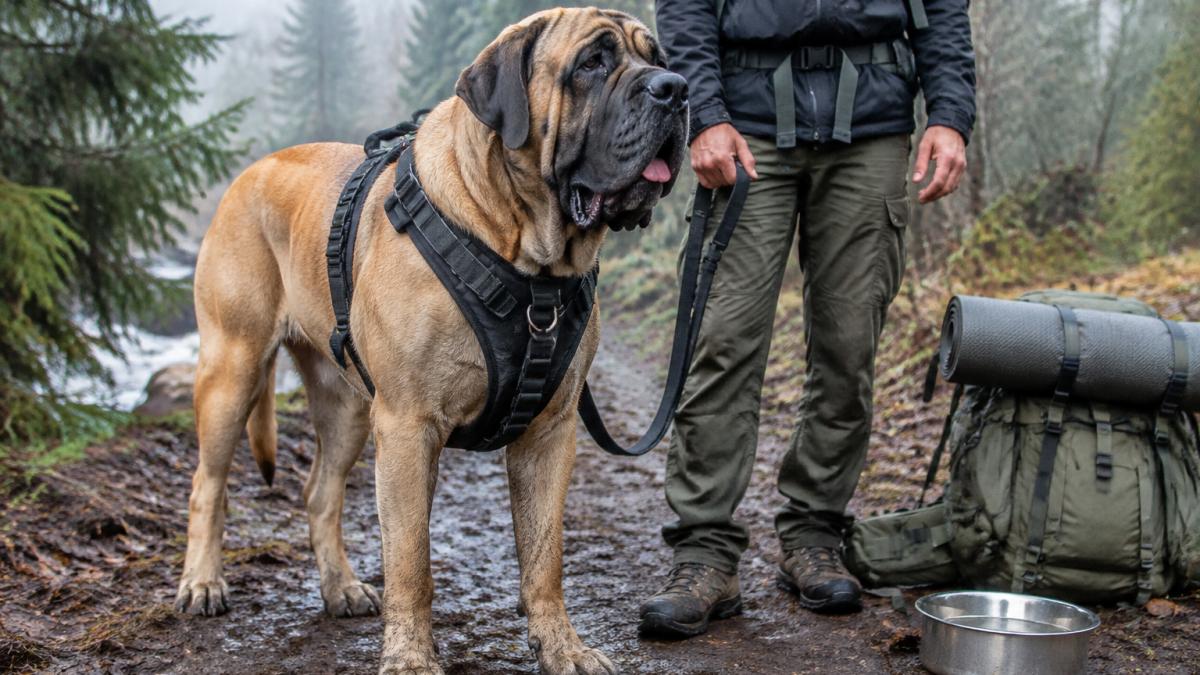
Trail gear for giant breeds has to survive mud, water, and rough ground without adding unnecessary weight to the dog. A padded harness with a sturdy handle lets you help the dog over obstacles, and a fixed lead with a locking clasp stays reliable when wet.
Bring a collapsible travel bowl and plan water stops around the dog, not the group. Giant breeds overheat faster than their size suggests, and a 150-pound dog drinks a lot. For camping, a stake-out line rated for the dog's weight and a raised bed that keeps them off cold, damp ground make the difference between a good night and a miserable one.
EXTERNAL_LINK: Fall hikes with your Mastiff prep checklist covers gear checks, paw care, and hydration for hiking with a 150+ pound dog.
Mobility, Recovery, and Senior-Dog Equipment
Senior giant breeds need gear that supports rather than restrains. A support harness with a rear lift handle lets you help an aging dog up stairs or into a vehicle without straining their joints or your back.
Ramps beat lifting for most large dogs. A ramp rated for the dog's weight, with a non-slip surface and low angle, protects both the dog's joints and your spine. Look for a weight limit clearly stated on the product, and check it against your dog with room to spare.
For recovery after surgery or injury, a padded harness with multiple lift points and a washable belly sling make daily care manageable. Watch out: a sling that is too narrow will cut into the dog's groin under load. Wider is better.
Choosing Your First Set of Colossal Canine Co. Gear
Start with the two pieces that carry the most load: a collar and a leash. At Colossal Canine Co., we build both from military-grade webbing and solid stainless steel hardware, engineered specifically for dogs over 100 pounds. Our collars and leashes are handmade to order, use Chicago-style tacks for load-bearing strength, and come with a lifetime guarantee.
If you are sizing a growing puppy, our adjustable designs accommodate rapid growth, so you are not rebuying every few months. EXTERNAL_LINK: Sizing a collar for a giant breed puppy walks through measuring and when to size up.
Dana R., who walks Atlas, a 150 lb Great Dane in Boise, is the kind of owner we build for. So is Marcus T. in Portland with Bruno, a 170 lb English Mastiff.
Frequently Asked Questions
What gear does a giant-breed dog need?
Every giant breed needs a properly fitted harness, a collar with load-bearing hardware, and a leash rated for its weight. Add a bed sized to its full length, a crate that meets its adult height, elevated bowls, and durable chews. For active dogs, add a raincoat, a travel bowl, and a ramp for vehicles. The best gear for giant breeds is gear rated above your dog's weight, not gear that merely fits.
How do I know a collar or leash will hold a dog over 100 pounds?
Check the hardware first: solid stainless steel D-rings and buckles beat plated alloys. Look for webbing rated by the manufacturer and stitching that is load-bearing, such as Chicago-style tacks or box-X stitching. Ask whether the maker publishes a weight limit. Durable collars for giant dogs should state a rating above your dog's weight, not just a size range.
Do giant dogs need a special harness?
Yes. A standard harness built for a 60-pound dog will rub and can fail at the seams under a 150-pound lunge. Look for a front-clip harness with wide, padded straps, a back handle for lifting, and adjustable points at the chest and neck. Front-clip designs give you steering control with strong, energetic dogs, while a back-clip point suits calm walking.
What should I look for in a collar for a giant dog?
Start with neck circumference, since many stores stop at 24 inches and giant breeds often exceed that. Check the width for pressure spread, the buckle type, and whether the D-ring is welded. A quick-release feature helps in emergencies, but confirm it locks securely. The best gear for giant breeds pairs a wide, rated collar with a backup connection point on the harness.
What gear is useful for hiking or camping with a giant dog?
Giant breed hiking and camping gear should include a padded harness with a lift handle, a heavy-duty leash for large dogs, a collapsible travel bowl, and a raincoat that covers the back and chest. A ramp or sling helps a tired dog into a vehicle. Carry a first-aid kit sized for large dogs and check that any pack or booties are rated for your dog's weight.
How do I choose durable gear for a dog over 100 pounds?
Compare three things: material, hardware, and warranty. Military-grade webbing and solid stainless steel hardware resist mud, water, and pulling force better than nylon and plated metal. Ask whether the maker offers a lifetime guarantee and how claims work. Proper sizing matters too, since a loose harness or collar shifts and wears faster on a strong dog.
If your current leash has already split once, or your collar buckle has popped open on a walk, you know the problem is not you. It is the gear. Choose Colossal Canine Co. for heavy-duty collars and leashes with military-grade webbing, solid stainless steel hardware, and a lifetime guarantee, and get equipment built for the dog you actually own.
