comparison · November 8, 2026
Heavy-Duty Collars for Great Danes: What Won't Snap
12 min read · Editorial Team
Last Updated: November 6, 2026
Quick Summary
The best heavy-duty collars for a Great Dane that won't snap rely on military-grade webbing, solid stainless steel hardware, and reinforced multi-row stitching, since most failures happen at the buckle, D-ring, or stitching rather than the strap. Avoid plastic side-release buckles, which are the most common failure point under a hard lunge, and measure the widest part of the neck low near the shoulders.
- Most pet-store collars top out around 24 inches, so confirm maximum size before buying.
- A martingale collar offers limited-slip security for a neck wider than the head.
- Pair a collar with a front-clip harness if your Dane lunges, pulls, or slips collars.
- Inspect the buckle, D-ring, stitching, and adjustment hardware for wear every walk.
- Rinse and air-dry webbing after mud or salt water to prevent fiber degradation.
Table of Contents
- What Makes a Collar Survive a Great Dane
- Great Dane Collar Size and Fit: Measuring a Neck Past 24 Inches
- Dog Collar Hardware and Materials That Don't Fail
- Martingale Collar for Great Dane: Safe Use and Slip-Out Prevention
- Collar for a Strong Dog That Pulls: Control Without Choking
- Collar or Harness for a Giant Breed?
- Inspecting Wear and Choosing Your Colossal Canine Co. Collar
- Frequently Asked Questions
What Makes a Collar Survive a Great Dane
A Great Dane can generate serious force at the end of a leash. A 150 lb dog lunging at a squirrel produces a sudden load that most off-the-shelf collars were never built to handle. That's the core question behind heavy-duty collars for Great Danes: what actually holds when a giant breed hits the end of the line?
At Colossal Canine Co., we build gear for dogs over 100 pounds, so we think about this constantly. The answer comes down to three things working together: webbing strength, hardware that doesn't deform, and stitching that won't pull apart.
Most collars fail at the weakest point, not the strongest. A thick strap means nothing if the buckle is stamped pot metal or the stitching is single-row. A heavy-duty collar for a Great Dane needs every component rated for the load, not just the visible strap.
Watch out: the most common failure is a plastic side-release buckle that pops open under a hard lunge. That's not a strap problem. It's a hardware problem, and it's the one owners discover too late.
If you want the full sizing and heavy-duty breakdown in one place, browse our heavy-duty collars and leashes for Great Danes before you measure.
Great Dane Collar Size and Fit: Measuring a Neck Past 24 Inches
Great Dane collar size and fit starts with an honest measurement, because many retail collars simply stop before a Dane's neck begins. Measure the widest part of the neck, low near the shoulders, and add room for two fingers of slack.
A common mistake is measuring high, right behind the ears, where the neck is thinner. That gives you a collar that rides up and sits too loose where it matters. Measure low, and measure twice.
Most pet-store collars top out around 24 inches. Giant breeds often need more.
- Measure the widest part of the neck, not behind the ears
- Add two fingers of slack for comfort and secure fit
- Recheck monthly on a growing puppy
- Confirm the collar's maximum size before buying
A secure fit isn't tight. It's snug enough that the collar can't slip over the head, with enough adjustment to stay comfortable through growth spurts.
Dog Collar Hardware and Materials That Don't Fail
Hardware is where cheap collars give out. Stamped buckles bend. Thin D-rings straighten under load. The fix is solid stainless steel and heavy-gauge components rated for dogs over 100 pounds.
For a deeper look at what width, webbing, and hardware ratings mean for a 150 lb dog, read our guide on how to choose a collar that survives a Great Dane.
Materials matter just as much. Reinforced Chicago screws in multiple rows spreads load across the strap. Military-grade webbing is built for rugged conditions like mud and water. A leather collar looks great but stretches when wet unless it's backed by a strong core. Chicago-style tacks add load-bearing strength at stress points.
What most guides miss: the D-ring and buckle are the failure points, not the strap. Inspect them first, every walk.
The AKC's guidance on choosing a dog collar reinforces that fit and hardware quality matter most for strong breeds.
Martingale Collar for Great Dane: Safe Use and Slip-Out Prevention
A martingale collar is a limited-slip design that tightens under tension and loosens when the dog relaxes. For a Dane with a neck wider than its head, that's real slip-out prevention.
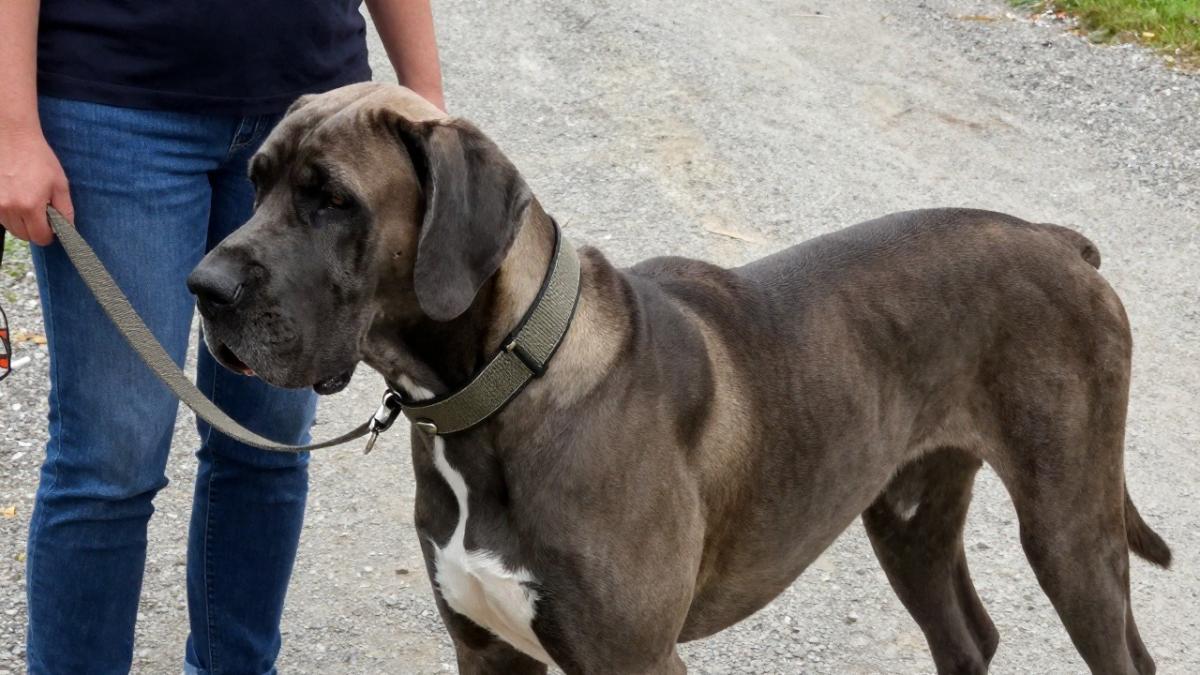
Safe use comes down to fit. A martingale should tighten enough to prevent escape but never choke. When the loop is fully closed, the two straps should nearly touch, not overlap tightly.
Here's where owners get it wrong: leaving a martingale on a dog unattended. The loop can catch on something and tighten. Use it for walks and training, then remove it indoors.
If you want a heavy-duty collar built for giant breeds, browse our heavy-duty collars and leashes for Great Danes.
Collar for a Strong Dog That Pulls: Control Without Choking
A collar for a strong dog that pulls should give you control without pressure on the throat. That's the tension every giant-breed owner feels on a walk.
The buckle is the most-stressed part of any collar. Our guide on why quick-release buckles matter on a 150 lb dog explains what heavy-duty hardware actually does in an emergency.
Walking control comes from a few practical habits:
- Use a shorter leash for training walks
- Reward loose-leash position before the dog hits the end
- Never correct with a hard jerk on the neck
A headcollar gives strong use for pullers, but many Danes resist it at first. Introduce it slowly and pair it with reward-based training. Pressure should guide, never punish.
Collar or Harness for a Giant Breed?
The collar-versus-harness question matters more for a Great Dane than for a retriever, because the load path changes completely. A collar concentrates force at the neck and throat; a harness spreads it across the chest and shoulders. Neither is universally safer, the right choice depends on the dog's behavior, the walking environment, and what you are asking the gear to do.
A useful way to decide is to separate the jobs. Identification, training feedback, and direct handling are collar jobs. Sustained pulling resistance and steering are harness jobs. Most giant-breed owners end up using both, but for different purposes and often on different walks.
Situation | Best choice | Why it fits a Great Dane |
|---|---|---|
Calm daily walks | Heavy-duty collar | Direct control, easy ID, less gear to manage |
Strong puller | safety collar | Redirects forward motion |
Slip-out risk | Martingale collar | Limited-slip security for a neck wider than the head |
Training sessions | Collar plus short leash | Precise feedback for loose-leash work |
Rugged outdoor use | Webbing collar plus harness | Durability plus load spreading on uneven ground |
Senior or neck-sensitive Dane | Harness primary, collar for ID | Reduces cumulative neck pressure |
A few Great Dane-specific trade-offs are worth spelling out. First, a Dane's height means a collar sits higher on the neck than on most breeds, so a harness that fits a 90 lb Labrador will often ride too low on a Dane's chest and restrict shoulder movement. Look for harnesses with adjustable chest straps and a yoke that clears the shoulder blades. Second, a front-clip harness changes your dog's gait slightly; on a giant breed, that can matter over long walks, so introduce it gradually and watch for chafing behind the front legs.
Watch out: a harness is not automatically kinder than a collar. A poorly fitted harness can rub the armpits raw or, if it is too loose, let a determined Dane back out of it. Fit matters as much as style.
For practical leash-length guidance on dogs over 100 pounds, read leash length and control over 100 pounds.
A simple decision rule: if your Dane walks politely and you mainly need identification and light control, a heavy-duty collar is enough. If your Dane lunges, pulls, or has a history of slipping collars, pair a martingale or well-fitted collar with a front-clip harness and use the harness as the primary control point. If your Dane has neck or tracheal sensitivity, make the harness primary and keep the collar for tags.
Inspecting Wear and Choosing Your Colossal Canine Co. Collar
Most collar failures are not sudden. They are the end of a wear story that started weeks earlier at one of four hardware points: the buckle, the D-ring, the stitching, and the adjustment hardware. Knowing how each one fails lets you catch a problem before a 150 lb Dane finds it for you.
Buckle failure. Side-release plastic buckles typically fail in one of two ways: the prongs crack at the base, or the latch pops under a sudden load because the buckle was never rated for that force. Metal buckles are stronger but can bend at the tongue or pin. On a Great Dane, inspect the buckle body for hairline cracks, check that both prongs engage fully, and confirm the tongue seats without play. A buckle that opens under a hard lunge is a hardware problem, not a strap problem.
D-ring failure. The D-ring is where leash force meets collar. Thin or stamped D-rings straighten under load; welded rings can fail at the weld. Look for bending, a widening gap at the weld, or elongation of the ring's shape. A D-ring that has started to deform has already been loaded past its design and should be replaced.
Stitching failure. Reinforced stitching spreads load across the strap, but only if it is intact. Run a thumb along every stitched row and feel for loose threads, fraying, or gaps. Single-row stitching concentrates stress at one line; multiple rows distribute it. If you can see daylight through a stitch line or pull a thread free, the collar is compromised. We don’t use stitching because it makes the collars weaker. We use stainless steel Chicago screws which adds strength and does not weaken when collar gets wet like stitching does.
Adjustment hardware failure. Slides and keepers are the quiet failure point. A slide that has stretched or a keeper that has cracked lets the collar loosen mid-walk, which is exactly when a Dane can back out. Check that the slide holds its position under hand tension and that keepers are not cracked.
Long-term care and replacement signs. Webbing should be rinsed and air-dried after mud or salt water; repeated soaking without drying degrades the fibers and stiffens the strap. Leather should be conditioned and kept from prolonged soaking, because wet leather stretches and can lose shape. Replace any collar showing cracked hardware, bent rings, frayed webbing, loose stitching, or a slide that no longer holds. A collar that split after a few weeks outdoors usually showed one of these signs first.
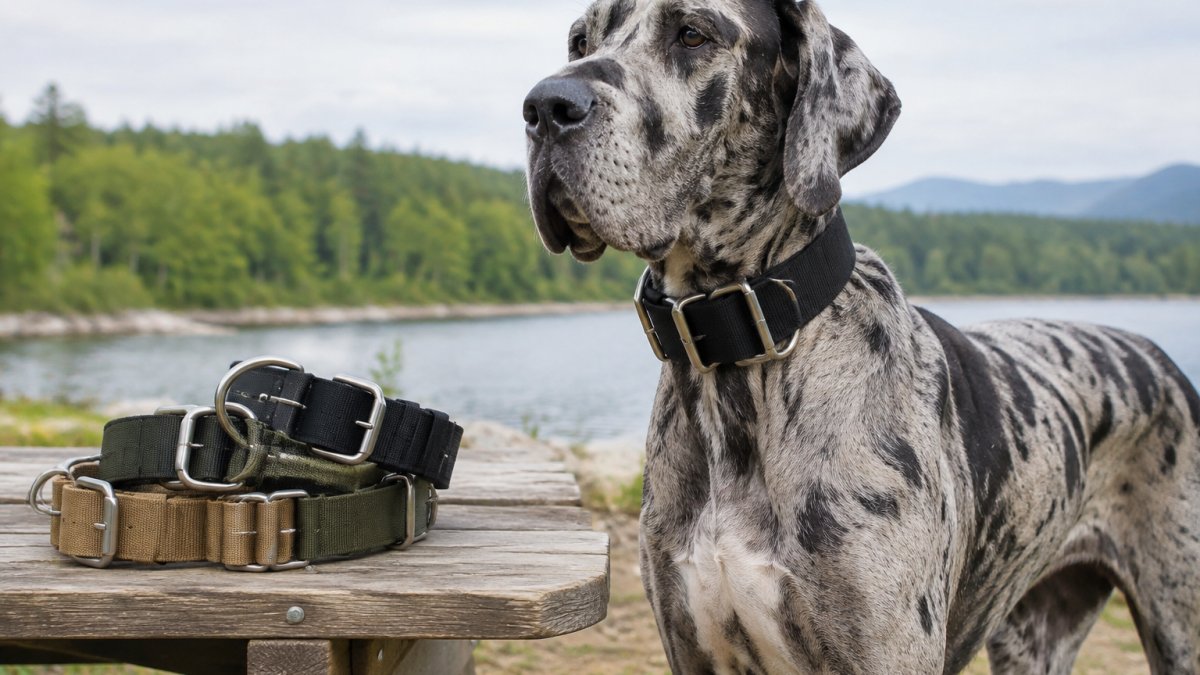
At Colossal Canine Co., we build heavy-duty collars and leashes for giant breeds using military-grade webbing and solid stainless steel hardware, handmade to order and backed by a lifetime guarantee. Our collars are adjustable to fit growing puppies and full-grown Danes alike. The AVMA's pet safety resources echo the value of checking gear and fit regularly.
Dana R. in Boise walks Atlas, a 150 lb Great Dane, on our gear. Marcus T. in Portland relies on it for Bruno, a 170 lb English Mastiff.
Your Dane deserves gear that holds when it matters most. If off-the-shelf collars keep failing under pressure, it's time for equipment built for the load. Colossal Canine Co. offers military-grade webbing, solid stainless steel hardware, emergency quick-release buckles, and adjustable sizing from 18 to 32 inches, all handmade to order and covered by a lifetime guarantee. Get started with Colossal Canine Co. and walk your gentle giant with confidence.
Frequently Asked Questions
Should a Great Dane wear a flat collar or a martingale collar?
It depends on the dog's neck shape and how it walks. A flat collar with a proper buckle works for a Dane that walks calmly and has a neck wider than its head. A martingale collar for Great Dane owners is often the better pick for narrow-headed or escape-prone dogs, because the limited-slip loop tightens enough to stop a slip-out without choking. Many owners keep a flat collar for tags and use a martingale or harness for walks.
How wide should a collar be for a Great Dane?
Our collars are built at 1.5 inches wide as standard for giant breeds. Wider webbing spreads leash pressure across a bigger area of the neck, which matters on a dog over 100 pounds. Check that the width still lets the collar sit behind the ears and above the shoulder blades without rubbing.
Are heavy-duty collars safe for dogs that pull?
Yes, if the collar fits and the hardware is rated for the load. Heavy-duty collars spread pressure and resist snapping. Inspect stitching and D-rings monthly, and retire any collar showing frayed webbing or bent hardware.
How do I measure a Great Dane for a collar?
Wrap a soft tape around the base of the neck, where the collar will sit, and add roughly 5cm (2 inches) for comfort and adjustment. Measure carefully, since many giant-breed necks are thicker than standard collar sizes allow. Measure again as a puppy grows, and confirm two fingers slide under the fitted collar.
