listicle · November 22, 2026
6 Leash Handle Styles Ranked for Long Walks
10 min read · Editorial Team
Quick Summary
The best leash handle styles for long walks are padded handles, which spread load across the palm and dampen surges. Double-handle leashes rank next for quick control, while hands-free designs suit hikers and runners.
- Padded handles spread load across the palm and fingers, reducing hand fatigue on long walks.
- Double-handle leashes let you switch grip positions and shorten the leash without stopping.
- Traffic handles work best as an add-on to a padded or standard handle in busy areas.
- Padding dries slowly, so wipe or air out padded handles after wet or muddy walks.
- For a dog that lunges at other dogs, choose a double-handle leash regardless of walk length.
Table of Contents
- Why Handle Style Matters More on Long Walks
- Comparison Table: Leash Handle Styles at a Glance
- Ranked: The Best Leash Handle Styles for Long Walks
- 1. Padded Handle: Best Overall for Long Walks
- 2. Double-Handle Leash: Best for Control and Grip Switching
- 3. Traffic Handle: Best Add-On for Busy Areas
- 4. Standard Loop Handle: Best for Routine Walks
- 5. Hands-Free and Convertible Designs: Best for Hiking and Running
- How the Ranking Changes by Dog and Condition
- Choosing Leash Length and Heavy-Duty Build for Large Dogs
- How to Choose the Right Handle for Your Walking Habits
- Pick Your Handle and Build Your Long-Walk Setup at Colossal Canine Co.
- Frequently Asked Questions
Why Handle Style Matters More on Long Walks
Most leash complaints come from the handle, not the length.
Handle design affects comfort after the first mile and control when your dog lunges. Three factors matter on long outings: how the grip distributes load, whether you can shift your hold without stopping, and how easily you can shorten the leash in a crowd.
Choose the handle first, then pick the length around it. A short walk can forgive a poor handle; a long walk with a large dog rarely does.
Comparison Table: Leash Handle Styles at a Glance
| Handle Style | Grip Points | Best For | Main Drawback |
|---|---|---|---|
| Standard loop handle | One | Short, routine walks | Hard on the hand over distance |
| Double-handle leash | Two | Close control and switching grips | Second handle can bunch up |
| Padded handle | One, cushioned | Long walks, big dogs | Heavier, slower to dry |
| Traffic handle | Secondary, near the collar | Quick shortening in busy areas | Only useful as an add-on |
| Hands-free / convertible | Waist or body belt | Hiking and running | Less direct control |
Ranked: The Best Leash Handle Styles for Long Walks
We ranked these styles by how well they hold up over distance, how much control they give you with a large, strong dog, and how comfortable they stay after an hour or more.
1. Padded Handle: Best Overall for Long Walks
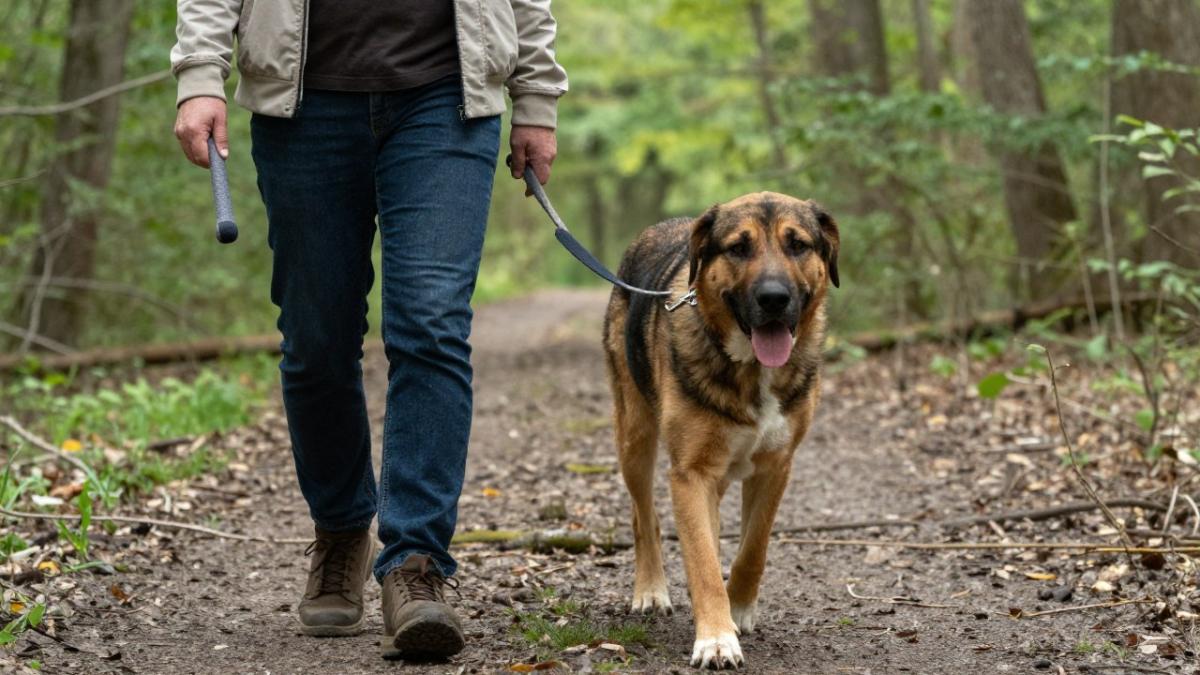
A padded handle spreads load across the palm and the base of the fingers instead of concentrating it in a thin loop.
Pros: Reduces hand fatigue over distance. Dampens shock from sudden surges.
Cons: Padding absorbs moisture and dries slowly. It adds weight and bulk.
Best for: Owners walking large or strong dogs for an hour or more, especially in cool or dry conditions.
2. Double-Handle Leash: Best for Control and Grip Switching
A double-handle leash places a second handle near the dog end, giving you a second grip position.
Pros: Lets you switch hands and positions without stopping. Gives close control in tight spaces.
Cons: The secondary handle can bunch up or swing and catch on brush. Extra hardware adds weight.
Best for: Owners who need to shorten the leash quickly and often.
3. Traffic Handle: Best Add-On for Busy Areas
A traffic handle is a short loop near the collar end that lets you grab the leash directly behind the dog's neck for instant shortening.
Pros: Fast control without untangling the full line. Keeps your hand close to the dog when you need it.
Cons: Only useful as an add-on. The short loop can be awkward for large hands or gloved hands.
Best for: City walkers and anyone whose route passes frequent distractions. Pair it with a padded main handle for long outings.
4. Standard Loop Handle: Best for Routine Walks
A standard loop handle is the baseline every other style is measured against: light, simple, and easy to clean, which makes it reasonable for short, routine walks.
Pros: Lightweight, simple, easy to clean. No extra hardware to fail.
Cons: Hard on the hand over distance. Offers only one grip position.
Best for: Short neighborhood walks and dogs that walk on a loose leash. If your walks regularly exceed an hour, move up this list.
5. Hands-Free and Convertible Designs: Best for Hiking and Running
Hands-free leashes attach to a waist belt, freeing both hands for trekking poles, a water bottle, or a jog, and some convertible designs can also be held as a regular leash.
Pros: Frees your hands on hikes and runs. Convertible models offer a backup grip option.
Cons: You have less direct control over sudden lunges. Waist belts need to fit well to avoid sliding.
Best for: Hikers and runners who want both hands free on uneven ground, and who have a dog with reliable recall and manageable pulling.
How the Ranking Changes by Dog and Condition
The order above assumes a large dog and a walk of an hour or more, and it shifts in three situations. For a small dog that rarely pulls, the standard loop handle moves up because weight and simplicity matter more than padding. In hot, humid weather, bare webbing is easier to keep dry, so the padded handle's advantage narrows. For a dog that lunges at other dogs, the double-handle leash moves to the top regardless of distance, because control in the moment outweighs comfort over the mile.
Choosing Leash Length and Heavy-Duty Build for Large Dogs
Handle style and leash length work together. A long line gives a dog room to explore, but it also gives a 150-pound dog room to build momentum before you can react.
For large dogs, build quality matters as much as handle design. Look for stitched webbing rather than glued seams, hardware rated well above your dog's weight, and a clip that cannot open under load.
For a mastiff or similar breed, a 6-foot leash with a secure handle gives more control than a long line in busy areas. Compare mastiff collar and leash sets to pair a fuller heavy-duty setup with that length.
How to Choose the Right Handle for Your Walking Habits
Start with the walk you take most often, not the one you take once a year. Then narrow by fit, conditions, and technique.
Match the Handle to Your Walk
- Daily neighborhood walks: A standard or double-handle leash with a comfortable loop is usually enough.
- Long hikes or extended outings: Choose a padded handle, and add a traffic handle if your dog pulls toward other animals.
- Running or fast trail walks: Consider a hands-free or convertible design so both hands stay free.
Fit the Handle to Your Hand
Loop width and opening size matter more than most buyers expect. Too narrow concentrates pressure across a thin band of the hand; too wide lets the leash slide and forces a harder grip.
If you have grip limitations such as arthritis or reduced hand strength, look for a padded handle with a firm, structured core rather than soft foam that collapses under load.
Manage Heat, Moisture, and Friction
Long walks generate sweat, and wet hands on webbing or foam change how a handle behaves. Padded handles absorb moisture and dry slowly, while bare webbing dries faster but cushions less.
Friction shows up as hot spots where the loop rubs against the base of the fingers or the palm. A glove with a reinforced palm can reduce friction, and switching hands regularly spreads the load.
Hold and Switch Handles Safely
Hold a standard loop with your hand through the loop and your thumb outside it, so the leash cannot cinch tight around your wrist if the dog lunges.
Watch out: A sudden lunge during a grip change is when drops and injuries happen, so practice switching in a quiet area before you rely on it near traffic or other dogs.
Test Before You Commit
Hold the handle with the leash taut, then switch hands and check whether your grip still feels secure. Test with gloves on if you walk in gloves, and with damp hands if you walk in heat or rain.
Pick Your Handle and Build Your Long-Walk Setup at Colossal Canine Co.
If your dog weighs over 100 pounds, the handle is only one part of a safe setup. Colossal Canine Co. builds heavy-duty collars and leashes for giant breeds, using military-grade webbing and solid stainless steel hardware, with a lifetime guarantee. Browse the single-color leash range to see the options built for giant-breed strength.
For a complete long-walk kit, the collar and leash bundle pairs a matching collar with a heavy-duty leash so the two work together. Pricing depends on your size and configuration, so check the site for current pricing or request a quote before you buy.
Start with the handle style that matches how you walk. Then build the rest of the setup around it.
Frequently Asked Questions
What is the best leash handle for long walks?
For most long walks, a padded handle is the most comfortable choice because it spreads pressure across the palm instead of digging into the fingers over time. Double-handle leashes are a strong second option when you want a second grip near the dog for closer control on busy paths. Hands-free designs suit walkers who want their hands free, though they give less direct control over a powerful dog. Consider how far you walk, how strong your dog pulls, and whether you need quick access to a close grip, then choose the handle that fits those conditions best.
Are double-handle leashes good for long walks?
Double-handle leashes work well on long walks where you need flexibility. The main handle stays at a relaxed walking length, while the second handle near the dog lets you shorten control quickly when you pass other dogs, people or obstacles. The benefit is switching between a relaxed grip and close control without fumbling with a clip or loop. Check that the second handle is positioned where your hand can reach it comfortably, and test the switch before a long outing.
What is a traffic handle on a dog leash used for?
A traffic handle is a short secondary loop placed near the clip end of the leash. It gives you a closer grip on the dog when you need to shorten control, such as crossing a road, passing a crowded area or managing a dog that lunges. Many handlers use it for emergencies, so it should be easy to grab without taking your eyes off the dog. For long walks, pair a comfortable main handle with a traffic handle for the most flexible control.
Is a padded dog leash handle better for long walks?
Yes, a padded handle is usually better for long walks because hours of holding a leash can cause hand fatigue, pressure points and blisters. Padding reduces that pressure and makes it easier to keep a steady grip as you walk. Padding does not replace a secure hold, so look for a handle that is still firm and reasonably sized for your hand. Padded handles are especially helpful for owners walking large dogs over longer distances.
