Collars · November 11, 2026
Strongest Dog Collars for Cane Corsos: What Actually Matters?
8 min read · Colossal Canine Co.
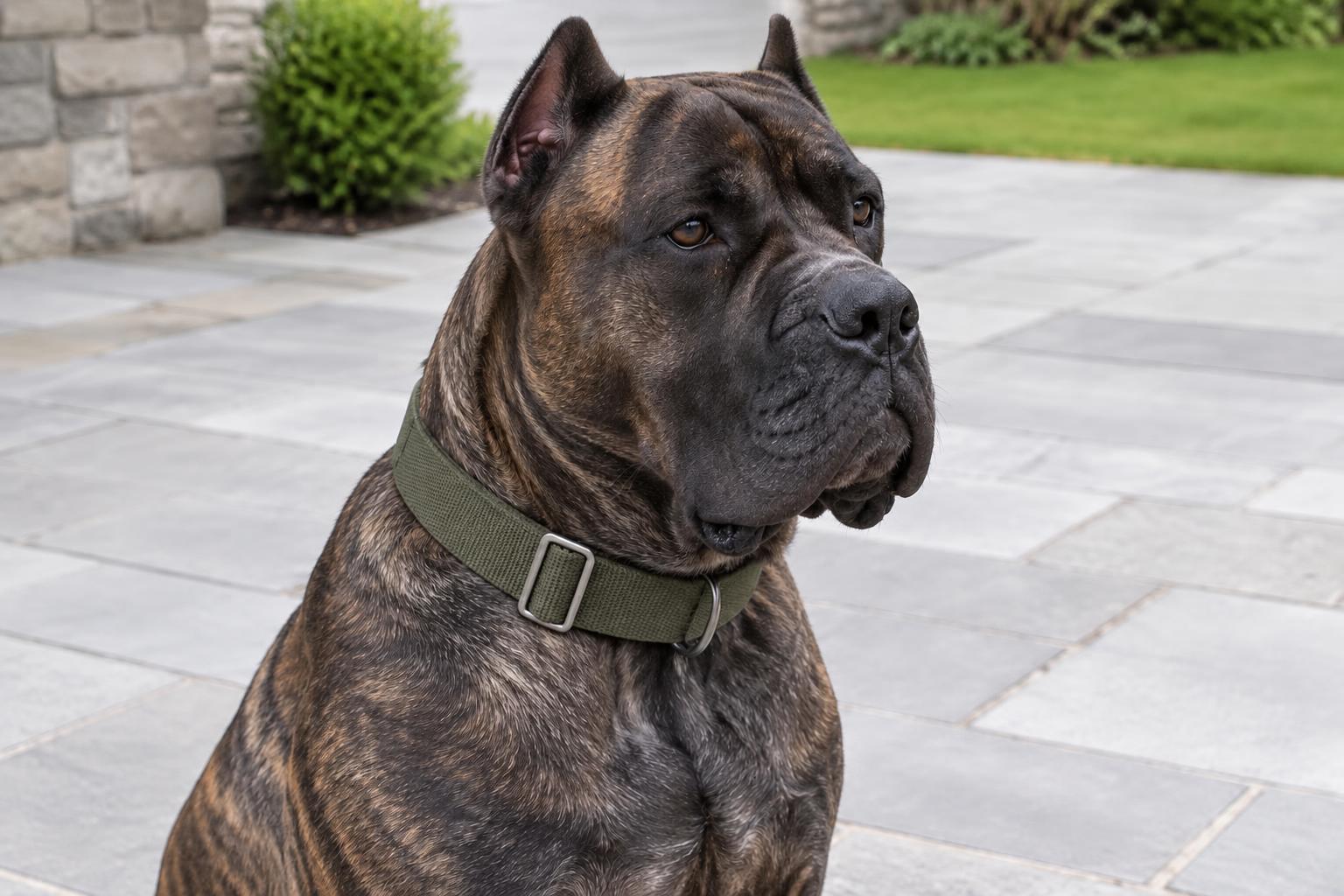
Why a dependable collar is about the whole construction—not just the biggest strength number.
The strongest dog collars for Cane Corsos are not necessarily the ones with the thickest straps, the largest buckles, or the most impressive numbers in an advertisement. A dependable collar needs a sound load path: the leash attachment, its connection to the strap, the adjustment system, and the closure must all work together. One weak connection can undermine otherwise excellent materials.
For a powerful, broad-necked dog, strength also has to coexist with comfort and correct fit. This guide explains what tensile claims really mean, how hardware and fasteners can fail, and what published testing can—and cannot—tell you. It does not rank products using invented laboratory results.

Strap tensile strength is only one part of the story
Tensile strength describes resistance to being pulled apart under specified conditions. A webbing supplier may report the breaking force of a straight, new strap sample. That is not automatically the breaking force of a finished collar, and it is not a safe working load for a dog.
Once webbing passes around hardware, is stitched, or has holes made for fasteners, its behavior changes. Abrasion, damaged edges, ultraviolet exposure, and contamination can also affect performance over time. A new material specification cannot guarantee the condition of a collar after months of use.
Ask whether a quoted number applies to the raw strap, a buckle, a leash, or the complete assembled collar. Ask for the test method, sample size, conditioning, and actual failure location. A number without those details is difficult to compare fairly.
Units matter too. Pounds-force and newtons measure force; a dog's weight is not a direct prediction of the force produced by a sudden lunge. Do not choose equipment by simply matching a breaking-strength number to your Cane Corso's body weight.
Materials and width: strong enough without excess bulk
Good woven webbing can provide flexibility, practical cleaning, and a comfortable surface. Leather can also be durable when its quality, thickness, care, and hardware are appropriate. Neither material wins automatically. Poor construction can make a heavy leather collar less dependable than a thoughtfully assembled webbing collar.
A wider strap can spread contact over more neck area, but width alone does not prove tensile strength. The weave, fiber, thickness, edge finishing, and connections all matter. A very wide collar can crowd the jaw, rub loose skin, or interfere with movement if it is unsuitable for that individual dog.
Measure where the collar will sit, check comfortable clearance, and watch your dog turn its head, lower its muzzle, and lie down. An adult Cane Corso's substantial neck does not make every oversized collar appropriate. Puppies need equipment that fits their present proportions rather than their anticipated adult size.
Hardware ratings: ask what was actually measured
Buckles and leash rings should be considered as separate components with separate jobs. A metal buckle may offer useful robustness, but the word “metal” does not identify the alloy, manufacturing process, closure geometry, or tested strength. Likewise, a well-designed polymer buckle should not be dismissed solely because it is not metal.
Breaking strength is the force at failure under a particular test. A working-load rating is a different claim and should come with the manufacturer's intended conditions and safety assumptions. Never invent your own safe working load by applying an arbitrary fraction to a collar's advertised breaking strength.
A side-release buckle must engage fully on both sides. A pin buckle needs a sound frame, intact tongue, and undamaged holes. A leash ring needs secure anchoring; an impressive ring does little if the strap loop holding it tears away. A separate identification-tag ring should not be treated as a leash attachment unless the manufacturer explicitly intends it for that purpose.
Look for corrosion, bent parts, burrs, sticky releases, incomplete engagement, and unintended openings. Test the closure by hand before each walk, without putting a dog under a test load.
Stitching: inspect the joint, not just the pattern
Box stitches and bar tacks are familiar reinforcement methods, but an attractive pattern is not evidence of a tested load capacity. Thread choice, stitch spacing, webbing overlap, material compatibility, and workmanship determine how the seam behaves.
Too little reinforcement can leave a joint vulnerable; excessive closely spaced needle holes can also damage material. Inspect the attachment loop around the leash ring as carefully as the buckle end. Loose thread, broken stitches, opening seams, and fraying near a connection deserve immediate attention.
Stitching can be excellent construction. It is portrayed as inherently inferior to rivets or screws. What matters is whether the completed connection has been designed, assembled, and evaluated appropriately.
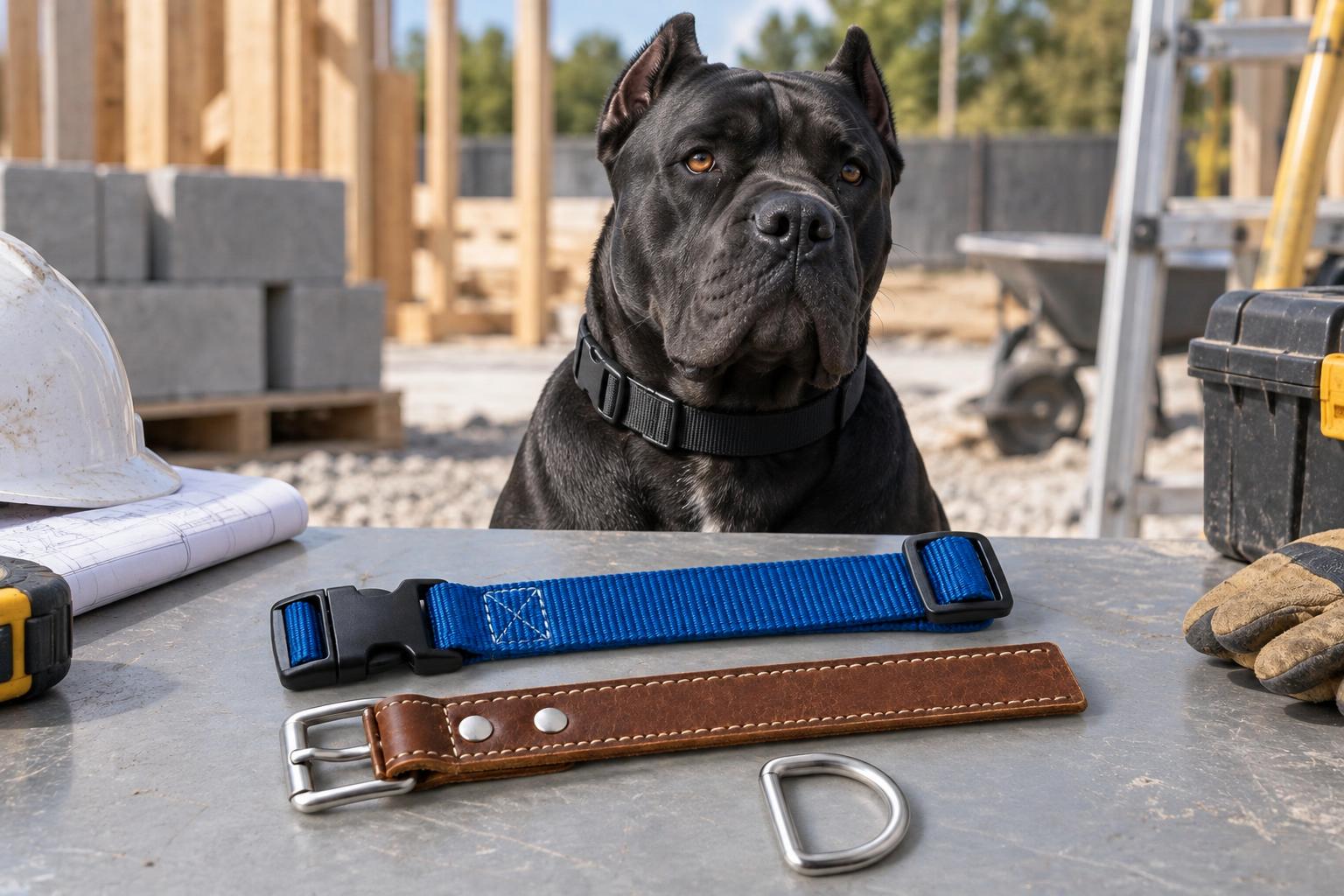
Rivets and Chicago screws: different fasteners, shared responsibilities
Rivets mechanically join layers, while Chicago screws use a threaded post and mating screw. These are different fastening systems, and neither should be described as indestructible. Their performance depends on dimensions, material, spacing, assembly, and how the surrounding strap carries the load.
A fastener can remain intact while the material tears around its hole. A loose threaded fastener can allow movement and wear. A badly set rivet may develop play or present a sharp edge. More fasteners do not automatically make a stronger collar if their placement weakens the strap.
Check for missing parts, movement, enlarged holes, corrosion, and strap damage. Follow the maker's maintenance instructions for threaded hardware rather than applying chemicals or tightening methods indiscriminately. If a structural fastener is loose or damaged, stop using the collar for leash attachment until the manufacturer advises a safe repair or replacement.
The failure points owners should watch
- Webbing edges: fraying, cuts, melted spots, or thinning where the strap rubs hardware.
- Closures: partial engagement, cracks, bent tongues, sticking mechanisms, or accidental release.
- Ring connections: torn loops, broken stitches, moving fasteners, or distorted rings.
- Adjustment systems: unexplained slipping that leaves the collar loose enough to escape.
- Leather and fastener holes: cracking, stretched holes, tearing, or layers separating.
Replace or professionally assess damaged equipment rather than waiting for complete failure. Never perform a destructive test while the collar is on a dog, and do not use a dog collar as lifting equipment or assume it is suitable for unattended tethering.
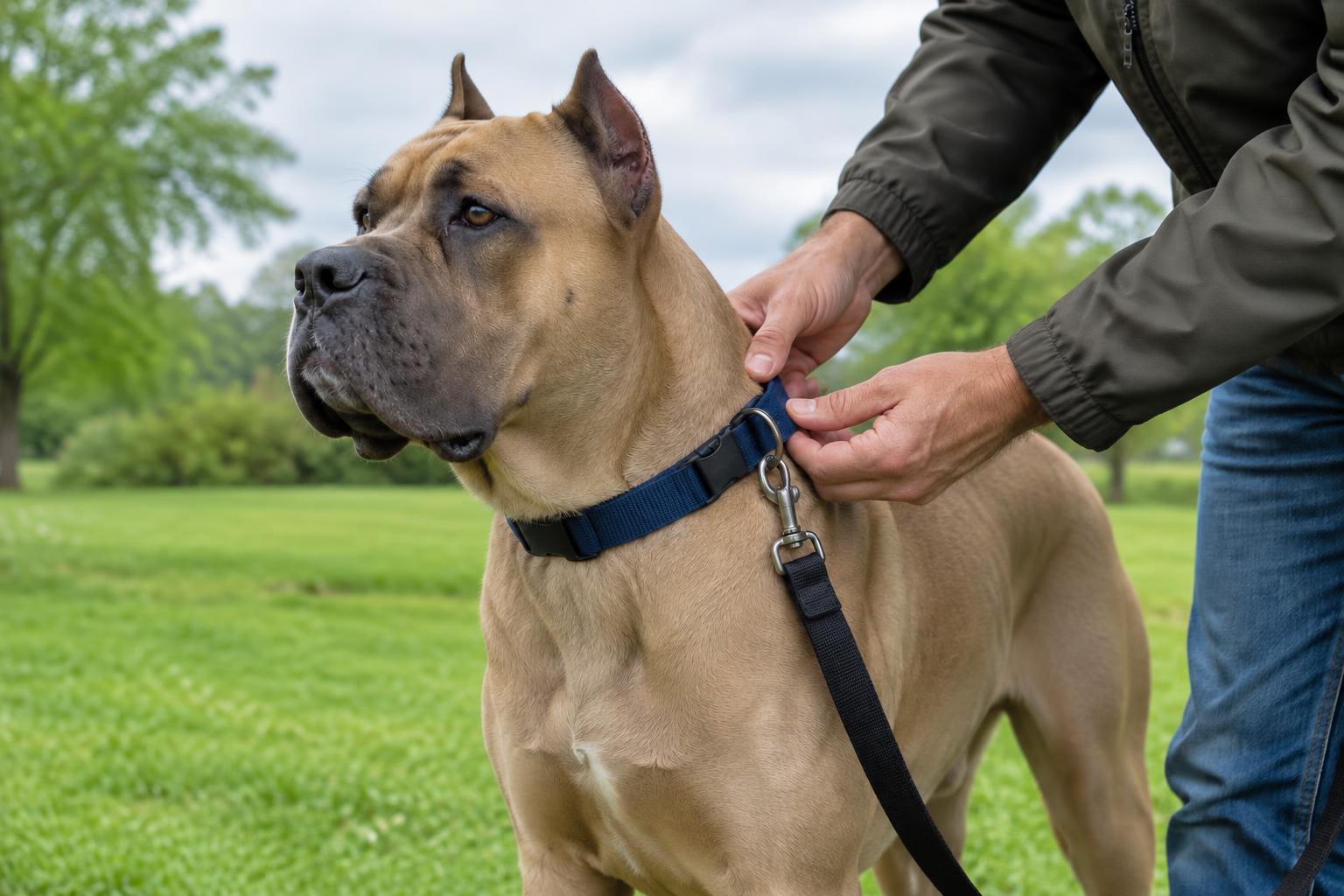
Where Colossal Canine collars fit
Colossal Canine Co. focuses on giant-breed sizing and handmade-to-order gear. The solid-color XXL collar is offered in neck sizes from 18 to 32 inches. The camo collar's current options run from 12 to 32 inches, and its description specifies 1½-inch-wide heavy-duty webbing. Select the model and size based on your dog's measurements, not the breed name alone.
Those are useful product characteristics, not proof of an ultimate strength ranking. Descriptions such as “heavy-duty” and “military grade” should not be interpreted as a published test standard unless supporting documentation identifies one. Buyers comparing alternatives should apply the same questions about assembly, hardware, care, and finished-product testing to every brand, including ours.
A better buying decision than chasing the biggest number
Start with fit, then examine the complete leash-to-collar connection. Favor clear specifications, consistent workmanship, usable maintenance guidance, and honest evidence over unsupported superlatives. Comfortable handling and training remain important; stronger equipment does not make repeated hard lunges harmless to a dog's neck.
For breed-specific fit considerations, visit the Cane Corso Breed Guide. To explore the brand and its current gear, visit the Colossal Canine Co. homepage.
The best answer to “What is the strongest collar for a Cane Corso?” is a collar whose entire construction suits the dog, whose limitations are clear, and whose condition you keep checking—not simply a strap with a large number attached.