comparison · November 9, 2026
Which Leashes Hold a 150lb Mastiff? 2026 Guide
11 min read · Editorial Team
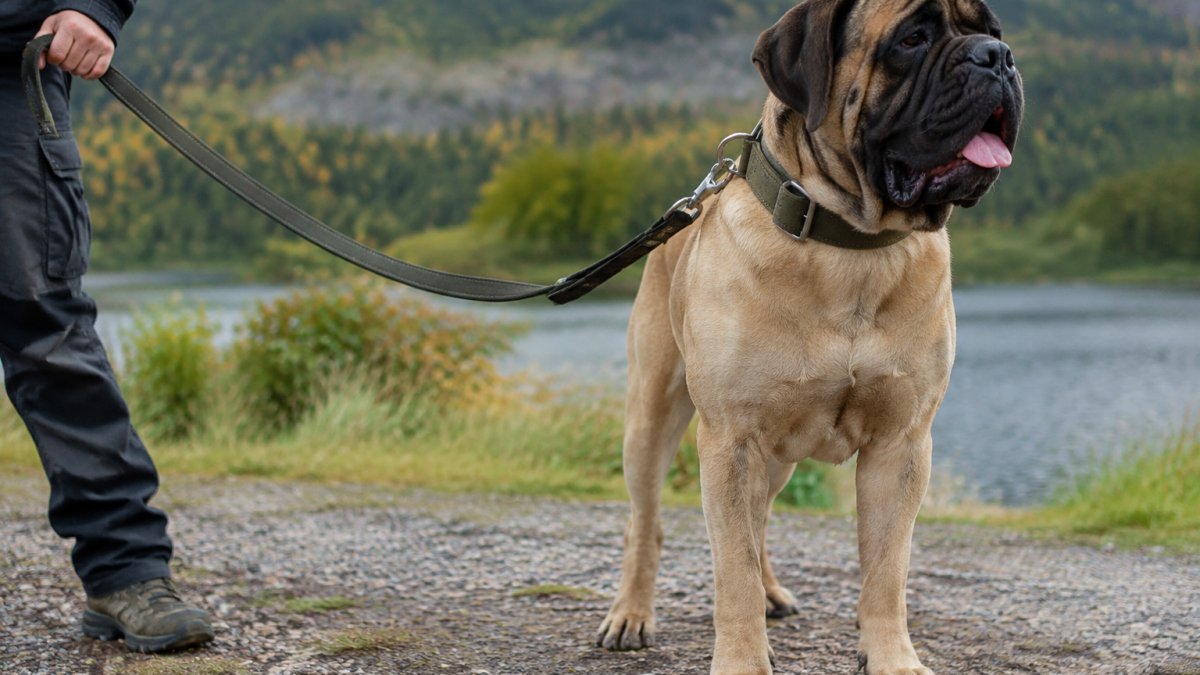
Last Updated: November 6, 2026
Quick Summary
The brands that make the strongest leashes for a 150lb Mastiff build them with wide military-grade webbing, solid stainless steel hardware, and reinforced stitching plus Chicago-style tacks. A mastiff leash should be a 6 ft fixed-length lead with a traffic handle, rated well above your dog's weight, since retractable leashes are not designed for giant breeds.
- Look for 1 to 1 1/2 inch wide webbing with a stated break strength of 1000 lbs.
- Check whether a break strength rating covers the webbing only or the assembled leash.
- Choose a 6 ft fixed-length leash with a padded main handle and a traffic handle.
- Skip retractable leashes for a 150 lb Mastiff because the cord and lock are weak points.
- Inspect webbing, stitching, hardware, and handle before every walk and monthly.
Table of Contents
- What Makes a Mastiff Leash Strong Enough for 150 lb?
- Heavy-Duty Leash for Large Dogs: Materials and Strength Ratings That Matter
- Best Leash for Large Dogs That Pull: Control Features for Lunging and Reactivity
- Best Dog Leashes for Pullers: Handles, Lengths, and Grip Compared
- Best Retractable Dog Leash for Strong Dogs: Safety Trade-Offs for a 150 lb Mastiff
- How to Inspect and Maintain Your Mastiff Leash
- Frequently Asked Questions
What Makes a Mastiff Leash Strong Enough for 150 lb?
A mastiff leash is only as strong as its weakest component, and for a 150 lb dog every part must be rated well above the animal's weight. Gear built for dogs over 100 pounds is designed for that load, while standard pet-store gear is not. A lunging Mastiff can generate force far beyond its body weight in a single burst, so the question isn't whether a leash holds a calm walk, it's whether it survives the squirrel.
Webbing, Hardware, and Stitching: The Three Failure Points
Webbing is the strap itself. Thin nylon stretches, frays, and tears under sustained load; heavy-duty leashes use wider, denser webbing so force spreads across more material.
Hardware covers the snap, clip, or carabiner. Cheap die-cast metal bends and pops open under sudden strain. Solid stainless steel holds its shape.
Stitching is where the handle and attachment point meet the strap. A single row of thread is a single point of failure.
Heavy-Duty Leash for Large Dogs: Materials and Strength Ratings That Matter
A heavy-duty leash for large dogs should combine wide nylon webbing, solid stainless steel hardware, and load-bearing stitching, with a stated break strength that leaves a wide margin above your dog's weight.
Here's how the materials compare:
| Component | Weak Version | Strong Version | Why It Matters |
|---|---|---|---|
| Webbing | Thin, stretchy nylon | Wide military-grade webbing | Resists fraying and tearing |
| Hardware | Die-cast zinc snap | Solid stainless steel clip | Holds shape under sudden load |
| Stitching | Single-row thread | Reinforced stitching plus tacks | Prevents seam failure |
| Handle | Bare nylon loop | Padded, reinforced handle | Grip and strain reduction |
The American Kennel Club's guidance on choosing leashes and collars makes a similar point: match the equipment to the dog's size and strength, not to what's on sale. That's the standard we build to, and you can see the 6 ft giant breed leash built to that spec if you want the numbers in front of you.
What a Break Strength Rating Actually Tells You
A break strength number is a laboratory figure for a new, undamaged component tested in a straight pull, not a guarantee the assembled leash will hold that load in the field.
A common pattern: a leash advertised with a high webbing rating uses unrated die-cast hardware, so the number describes the strongest part rather than the weakest. For a 150 lb Mastiff, look for a stated assembled-leash rating and hardware documented as stainless steel rather than "metal alloy."
How to Verify Hardware and Stitching Before You Trust a Leash
You can't run a tensile test at home, but you can inspect the parts that fail first:
- Clip gate: open and close it several times. It should snap firmly with no gritty feel and no side-to-side wobble in the gate.
- Clip body: look for a stamp indicating material or rating. Unmarked pot-metal hardware is a warning sign on a leash meant for a giant breed.
- Stitching: count the rows at the handle and clip. A single row of thread is a single point of failure; box-X or multi-row stitching with tacks distributes load across more material.
Matching the Leash to a 150 lb Mastiff
A 150 lb dog that lunges can generate brief force well above its body weight, and the leash has to survive that burst, not just a calm walk. A practical standard is wide webbing, solid stainless steel hardware, and reinforced stitching for a dog of this size. If you want the numbers in front of you, see the 6 ft giant breed leash built to that spec.
Best Leash for Large Dogs That Pull: Control Features for Lunging and Reactivity
The best leash for large dogs that pull is a fixed-length leash with two handles: a padded main handle for relaxed walking and a traffic handle near the clip for close control when your dog lunges. Length and grip decide whether you can actually hold a reactive Mastiff.
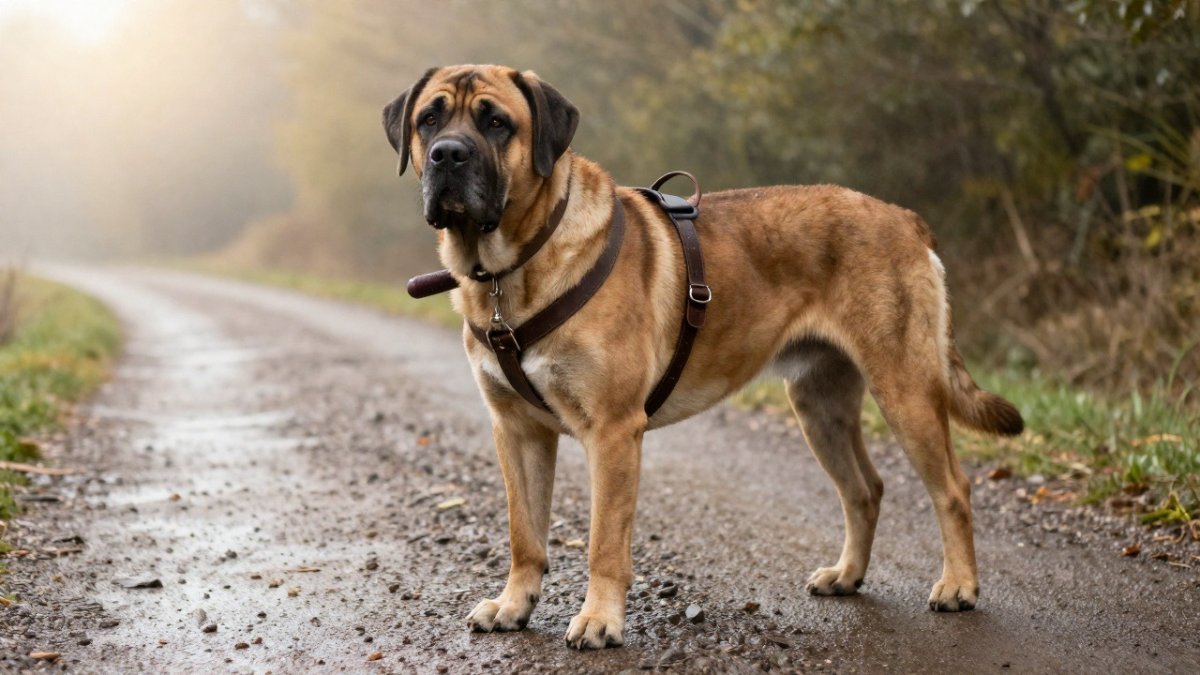
Control features that matter for a dog over 100 pounds:
- Traffic handle: shortens your grip instantly when another dog appears
- Padded grip: keeps the leash from cutting into your hand during a hard pull
- Fixed length: no sudden give when a retractable mechanism locks
A common mistake is buying a long line for a strong puller. More length means more momentum before the leash goes taut. If your dog outweighs your kids, our breakdown of leash length and control over 100 pounds walks through which styles actually give you the upper hand.
How a 150 lb Mastiff Changes the Control Equation
A Mastiff is a heavy dog with a low center of gravity and a long, powerful neck. When it lunges, force arrives low and forward, and a handler holding a thin leash at waist height has poor leverage. Three leash properties change that equation:
- Width: a 1 to 1 1/2 inch webbing spreads load across your hand and is easier to grip under tension than a thin strap that cuts in.
- Length: a 6 ft leash keeps the dog close enough that a lunge has less room to build momentum; a 10 ft line gives a powerful dog more speed before the leash goes taut.
- Handle placement: a traffic handle near the clip lets you shorten your grip and bring the dog close to your body, where your legs and core, not just your arm, can absorb the pull.
Handler positioning matters as much as the leash: keeping your leash hand close to your center of gravity and your feet staggered gives far more resistance than an extended arm. Equipment alone does not prevent pulling; it gives you the control to manage it while you train.
Choosing a Leash by Walking Scenario
The right leash for a Mastiff depends on where you walk, not just on the dog's weight:
| Scenario | Recommended Leash | Why |
|---|---|---|
| Neighborhood walks | 6 ft fixed-length, double handle | Close control near cars, dogs, and people |
| Training and recall | 10 ft long line in open ground | Distance for practice without losing connection |
| Hiking and trails | 6 ft fixed-length, reinforced handle | Durability and control on uneven ground |
| Crowded areas | 6 ft with traffic handle | Instant shortening in tight quarters |
| Retractable | Not recommended for a 150 lb Mastiff | Lock and cord are weak points under load |
Failure Modes to Watch For in Pull-Control Gear
Even good control gear fails in predictable ways. Check these before every walk:
- Traffic handle stitching: the second handle takes the hardest load during a lunge; look for loose or pulled threads where it meets the main strap.
- Clip gate: a gate that has bent or feels gritty can pop open under a hard pull.
- Padded grip: worn padding can slide or tear, reducing your grip exactly when you need it.
Best Dog Leashes for Pullers: Handles, Lengths, and Grip Compared
For the best dog leashes for pullers, grip and length matter more than anything printed on the packaging. A handle that slips or a length that's too long turns a strong dog into a runaway.
| Leash Style | Length | Best For | Main Trade-Off |
|---|---|---|---|
| Standard flat leash | 6 ft | Everyday walks, training | Less room to roam |
| Long line | 10 ft | Recall practice, open ground | More momentum when taut |
| Double-handle leash | 6 ft | Reactive or lunging dogs | Extra hardware to check |
| Retractable | Varies | Calm dogs only | Lock failures under load |
Length
A 6 ft leash keeps a Mastiff close enough to correct; a 10 ft option gives more room in open areas. If you're weighing the two, compare the 10 ft heavy-duty leash against the shorter version.
The handle is a control surface, not just a comfort feature.
Best Retractable Dog Leash for Strong Dogs: Safety Trade-Offs for a 150 lb Mastiff
A retractable leash is a poor match for a 150 lb Mastiff. The mechanism relies on a thin cord and a spring-loaded lock, both weak points when a heavy dog hits the end of the line at speed. Retractable leashes are not designed for giant breeds.
The trade-offs are concrete:
- Thin cord: concentrates force into a small area and can snap or cause burns
- Lock failure: a hard lunge can overwhelm the braking mechanism
- Constant tension: teaches a dog to pull against the leash rather than walk loose
For a strong dog, fixed-length heavy-duty leashes are the safer call. If you've been using a retractable and want to switch, you can browse the fixed-length leads built for giant breeds and pick a length that matches your walking routine. The Humane Society's advice on leash safety and walking equipment is worth a read on why control beats convenience with powerful dogs.
How to Inspect and Maintain Your Mastiff Leash
Inspect your mastiff leash before every walk and give it a full check monthly.
Run this checklist:
- Webbing: look for fraying, cuts, or faded, brittle sections
- Stitching: check for loose or pulled threads at the handle and clip
- Hardware: confirm the clip opens and closes smoothly with a firm spring
Rinse the leash after wet or dirty walks and let it dry before storing; a leash that stays damp can weaken over time.
Watch out: never ignore a clip that feels loose or gritty.
Our gear is handmade to order and backed by a lifetime guarantee.
If you've watched a flimsy leash stretch and fail under a lunging Mastiff, you already know the frustration.
Frequently Asked Questions
What leash is best for a 150-pound Mastiff?
A flat, heavy-duty nylon or braided leash with solid stainless steel hardware and a padded handle gives the most reliable control for a 150 lb Mastiff. Look for a width of at least 1 inch (25 mm), reinforced stitching, and a locking carabiner or heavy snap clip. Avoid thin or decorative leashes that rely on small metal components, because a single lunge can stress those parts beyond their limit.
Is a retractable leash safe for a strong Mastiff?
Retractable leashes are generally a poor match for a 150 lb Mastiff. The thin cord and plastic housing are designed for lighter dogs, and a sudden lunge can jam the locking mechanism or snap the cord. If you want some freedom on open ground, a long line gives you distance without the mechanical failure risk of a retractable.
What is the strongest type of dog leash?
A flat or braided leash made from military-grade nylon webbing with solid stainless steel hardware and Chicago-style tacks is the strongest common design. Braided leashes spread load across multiple strands, while flat webbing resists abrasion on rough ground. The weakest point is usually the clip or stitching, so check those first when comparing heavy-duty leash for large dogs options.
What leash length gives the best control over a large dog?
A 4 to 6 foot (1.2 to 1.8 metre) leash gives the best everyday control for a Mastiff. Shorter lengths keep the dog close in traffic or around other people. Reserve longer lines for training in open spaces where a lunge will not put anyone at risk.
