how-to · November 16, 2026
How to Choose a Reflective Collar for Great Danes at Night
11 min read · Editorial Team
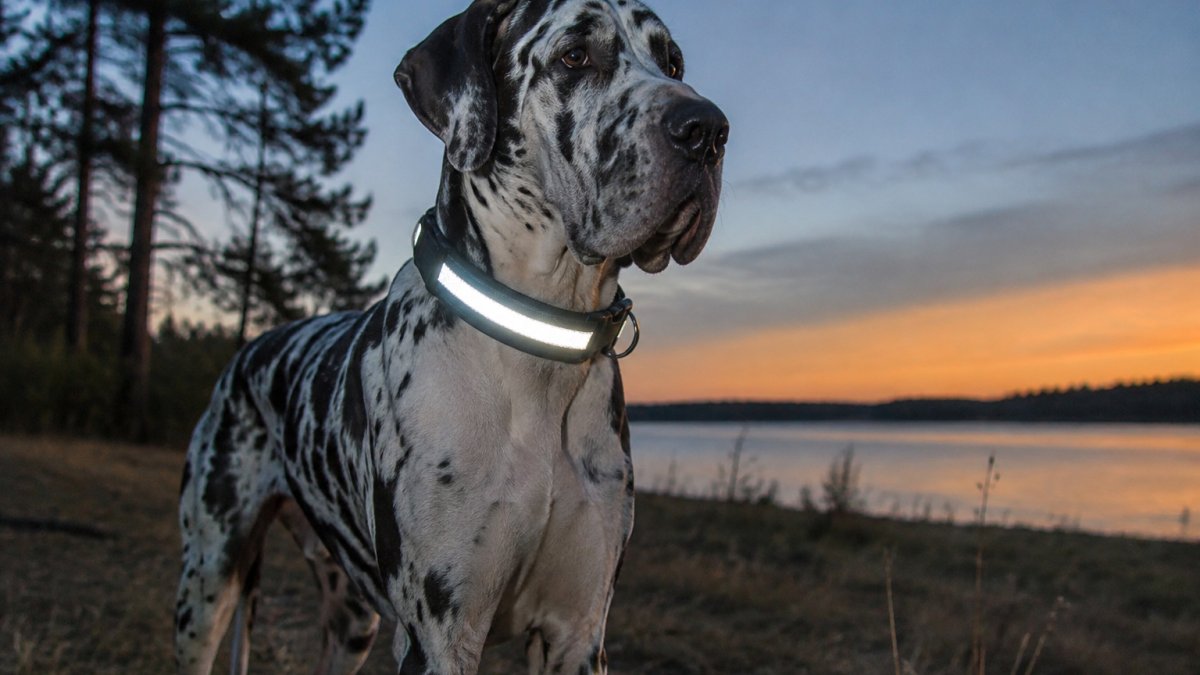
Last Updated: November 15, 2026
Quick Summary
Choose a reflective collar for Great Danes at night by pairing passive reflectivity with hardware that survives a giant breed's pull. Measure the base of the neck with two fingers of slack, test the band from twenty paces at driver height, and add a small light as backup.
- Measure every two to three weeks during rapid growth, since neck circumference changes faster than chest.
- A collar sized 18 to 32 inches with multiple adjustment points lets you resize without new hardware.
- Reflective material needs headlights or a torch; illuminated gear is self-powered but dies with the battery.
- Test visibility from twenty paces at three to four feet off the ground, checking front, side, and rear angles.
- Pair the collar with leash training and route choice, because reflectivity does not stop a driver.
Table of Contents
- Why a Reflective Collar for Great Danes at Night Needs More Than Shine
- Great Dane Collar Sizing: Measuring a Neck That Outgrows the Shelf
- Reflective Dog Collars: How the Visibility Actually Works After Dark
- What Makes a Heavy-Duty Collar for Great Dane Walks Hold Up
- Night-Walking Safety for Dogs: Testing Visibility and Building the Setup
- Choosing Your Reflective Collar at Colossal Canine Co.
- Frequently Asked Questions
Why a Reflective Collar for Great Danes at Night Needs More Than Shine
A reflective collar for Great Danes at night has to do two jobs at once, and most collars only do one. It must make a 150-pound dog visible to drivers, and it must survive the pressure of a dog that can lunge hard enough to snap standard hardware.
That second job is where most shopping decisions go wrong. A 2025 review of collars, harnesses, and head collars for walking by researcher C. Cavalli and colleagues concluded that all tested collars could potentially generate enough pressure to cause injury in dogs.
At Colossal Canine Co., we build gear for dogs over 100 pounds, so we think about this pairing constantly.
Great Dane Collar Sizing: Measuring a Neck That Outgrows the Shelf
Great Dane collar sizing starts with two measurements and a fit check, not a guess from the breed label. Most pet store collars stop well short of a giant breed's neck, and a collar that fits a 120-pound adolescent may be too tight or too loose six weeks later. You need the base-of-neck circumference, the widest chest circumference if your dog wears a harness, and a repeatable way to check fit as the dog grows.
How to Measure a Great Dane's Neck in Five Steps
- Stand your dog square on a flat floor, head up, not sitting or lying down. A sitting dog compresses the neck and gives a false reading.
- Wrap a soft tape measure around the base of the neck, where the collar naturally sits, just behind the ears and above the shoulder blades. Record the number in inches.
- Add two fingers of slack under the tape, then read the circumference again. This is your target collar size, not the raw neck measurement.
- Measure the widest part of the chest if your dog wears a harness, because a too-tight chest strap restricts shoulder movement on a deep-chested breed.
- Re-check the fit with the actual collar on the dog: you should be able to slide two fingers under the band at the base of the neck, and the collar should not slide over the head when the dog backs up.
Watch out: a collar that passes the two-finger test when the dog is calm can still be too loose during a lunge, so test the fit again after a short walk and adjust before trusting it near traffic.
Fitting a Growing Great Dane
A Great Dane puppy can outgrow a fixed-size collar in weeks, which is why adjustable sizing matters more for this breed than for a mature dog. Measure every two to three weeks during the rapid growth phase, and expect the neck circumference to change faster than the chest. For gear sized for this range and breed-specific fit guidance, see our Heavy-Duty Collars and Leashes for Great Danes.
Fit Checks for Deep-Chested Anatomy
A Great Dane's deep chest and narrow head create two fit problems: a collar loose enough to be comfortable can slip over the head, and a collar tight enough to stay on can press on the throat. Check that the collar sits at the base of the neck, not halfway down the throat, and that the D-ring hangs at the side or front rather than under the chin. If the collar slides forward when the dog lowers its head to sniff, it is too loose for leash control and should be paired with a martingale or headcollar for walks.
Reflective Dog Collars: How the Visibility Actually Works After Dark
A reflective band on a quiet street with no headlights nearby stays dark.
That distinction matters at dusk, when drivers' eyes are adjusting and street lighting is uneven.
Reflective Versus Illuminated: Which One Keeps a Giant Breed Seen
Reflective material is passive and needs an external light source. Illuminated gear, such as a light-up collar or clip-on beacon, produces its own light and stays visible with no headlights present.
| Feature | Reflective Collar | Illuminated Collar |
|---|---|---|
| Light source needed | Yes, headlights or a torch | No, self-powered |
| Battery required | No | Yes |
| Best for | Street walks with traffic | Off-lead areas, heavy fog |
| Failure risk | Wears if the band scuffs | Dies when the battery does |
The practical answer for most owners is both: a reflective collar as the base layer, plus a small light for backup. Browse high-visibility safety collars for big dogs if you want to compare options side by side.
What Makes a Heavy-Duty Collar for Great Dane Walks Hold Up
A heavy-duty collar for Great Dane walks holds up because of three things: webbing strength, hardware gauge, and how the load transfers to the buckle. Wide collar designs spread pressure across a larger area of the neck, which matters more on a large dog than on a small one.
Stitching is the quiet failure point. Chicago style tacks provide load-bearing strength at the stitching points. We use solid stainless steel hardware for durability in mud and water.
Martingale, Buckle, or Headcollar: Matching the Collar to the Dog
A martingale collar tightens slightly when the dog pulls, which helps with escape prevention on narrow-headed breeds. A buckle collar is the everyday choice for a dog that walks calmly.
- Martingale: best for dogs that back out of standard collars
- Buckle: best for trained walkers and daily wear
- Headcollar: best for pullers in training, paired with a flat collar for ID
Skip a martingale if your dog already walks loose, since the tightening action adds nothing. Our guide on how to choose a collar that survives a Great Dane breaks down width and hardware ratings in more detail.
Night-Walking Safety for Dogs: Testing Visibility and Building the Setup
Night-walking safety for dogs comes down to testing your setup under real conditions before you rely on it. A reflective collar is a passive visibility tool: it only performs when an external light source hits it, so the test is not whether the band looks bright in your hand but whether it flashes back from the distance and angle a driver would see it.
How to Test Reflective Visibility
- Step outside after dark on a street with typical lighting, not a fully lit driveway.
- Stand twenty paces from your dog and shine a phone torch at the collar from driver height, about three to four feet off the ground.
- Check the band from the front, from the side, and from behind. Side and rear angles are where most near-misses happen, because drivers approach from behind and pass at an angle.
- If the band does not flash back clearly at twenty paces, it is not doing its job for traffic visibility. Move to a brighter reflective collar or add an active light.
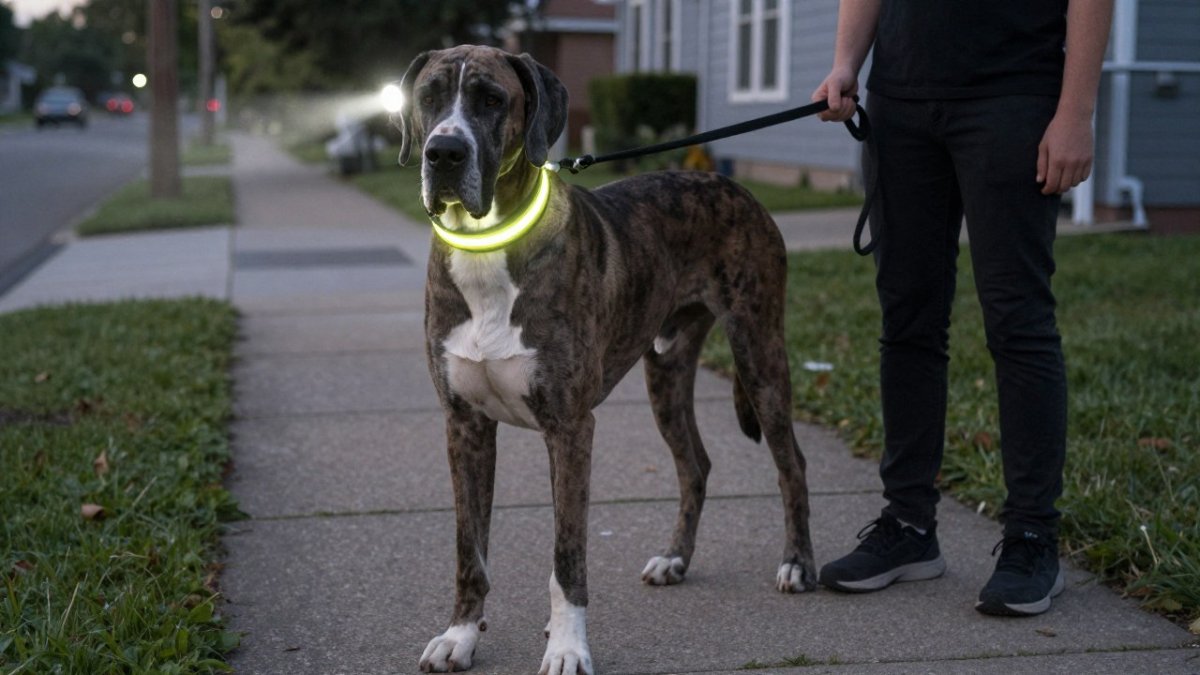
Reflective Versus Illuminated: Building a Layered Setup
Reflective material is passive and needs an external light source. Illuminated gear, such as a light-up collar or clip-on beacon, produces its own light and stays visible with no headlights present.
Control, Identification, and Route Choice
Build the rest of the setup around control. A dog that pulls drags you toward traffic, so pair the collar with leash training. Our step-by-step plan to stop dog pulling on leash covers the mechanics. Add identification tags and consider GPS tracking if your dog ranges far off-lead. Choose routes with sidewalks, cross at lit intersections, and walk facing traffic where there is no sidewalk so you can see approaching vehicles and react.
Choosing Your Reflective Collar at Colossal Canine Co.
The right reflective collar for Great Danes at night is the one that stays visible and stays intact.
We build ours from military-grade webbing and solid stainless steel hardware, handmade to order for dogs over 100 pounds.
Our customers put this gear through real conditions.
If your current collar has already failed once, don't wait for the second time. Start with our safety buckle collar rated for dogs over 100 pounds and walk after dark with confidence.
Your Great Dane deserves gear that matches its size, not gear that merely fits until the first hard pull.
Frequently Asked Questions
What is the best collar for a Great Dane at night?
A wide, heavy-duty reflective collar with solid metal hardware and soft padding is the practical starting point. Look for reflective material that wraps the full band rather than a small stitched strip, because a Great Dane's neck is thick and a narrow patch disappears from most angles. Pair the collar with leash control and check the fit often. Colossal Canine Co. builds collars for dogs over 100 pounds with military-grade webbing and stainless steel hardware.
Do reflective dog collars actually work in low-light conditions?
They work by returning light to its source, so a driver or cyclist needs their own headlights or a light pointed at the dog to see the glow. That means reflective dog collars are highly effective on lit streets and near traffic, but they do nothing in total darkness with no light source. Test yours by shining a torch at the collar from 20 to 30 metres on a dark evening. If the reflection is dull or patchy, the reflective elements have worn and it is time to replace the collar.
How do I choose a reflective collar that fits a Great Dane?
Measure the widest part of the neck with a soft tape, then add roughly two fingers of slack so the collar sits snug but not tight. Confirm the adjustable range covers your dog's neck before buying. Recheck the measurement every few weeks with a puppy, since giant breeds grow fast. A wide collar spreads load better than a thin one, and padded edges reduce rubbing on short-coated necks during long nighttime walks.
Are reflective collars enough to keep a dog visible at night?
Not on their own. Reflective elements only activate when light hits them, so night-walking safety for dogs usually means layering: a reflective collar, a reflective leash or harness panel, and an active light such as a clip-on LED for unlit routes. Keep the dog on a short lead near roads and carry a torch. Check the collar's stitching, buckle, and reflective band monthly, and replace any gear showing fraying, since a 150-pound Great Dane can stress hardware fast.
