comparison · November 24, 2026
Best Leash Attachment for a Mastiff Harness
10 min read · Editorial Team
Last Updated: November 23, 2026
Quick Summary
The best leash attachment for a mastiff harness is a front chest clip for training and pulling control, a back clip for relaxed walks with a trained dog, and dual attachment points when you want both options on one harness. Because a 170-pound English Mastiff generates strong pull forces, the attachment point must be rated for that load.
- A front clip turns leash pressure sideways, redirecting a pulling mastiff's momentum instead of fighting it head-on.
- A back clip sits between the shoulder blades and suits a mastiff that already walks politely.
- Dual attachment points let you switch from front to back without buying a second harness.
- Load-bearing strength comes from the D-ring, the stitching, and the webbing working together.
- Measure chest girth first, since that number decides the size, not the neck measurement.
Table of Contents
- What is the best leash attachment for a mastiff harness?
- Front clip vs back clip dog harness: which steers a mastiff
- Dog harness leash attachment points and the hardware that holds them
- The best dog harness for pullers and how to fit it to a mastiff
- Pairing a heavy-duty leash for large dogs with the right clip
- Choosing your Colossal Canine Co. setup for a 100-pound-plus dog
- Frequently Asked Questions
What is the best leash attachment for a mastiff harness?
The best leash attachment for a mastiff harness is a front chest clip for training and pulling control, a back clip for relaxed walks with a trained dog, and dual attachment points when you want both options on one harness. That matters because a 170-pound English Mastiff generates strong pull forces, so the attachment point has to be rated for that load.
At Colossal Canine Co., we build for dogs over 100 pounds every day, and the attachment question comes up more than any other. For a mastiff, clip position is a control decision, not a style preference.
Below, we break down front versus back versus dual clips, the hardware that holds them, and how to fit a mastiff harness so it actually stays put.
Front clip vs back clip dog harness: which steers a mastiff
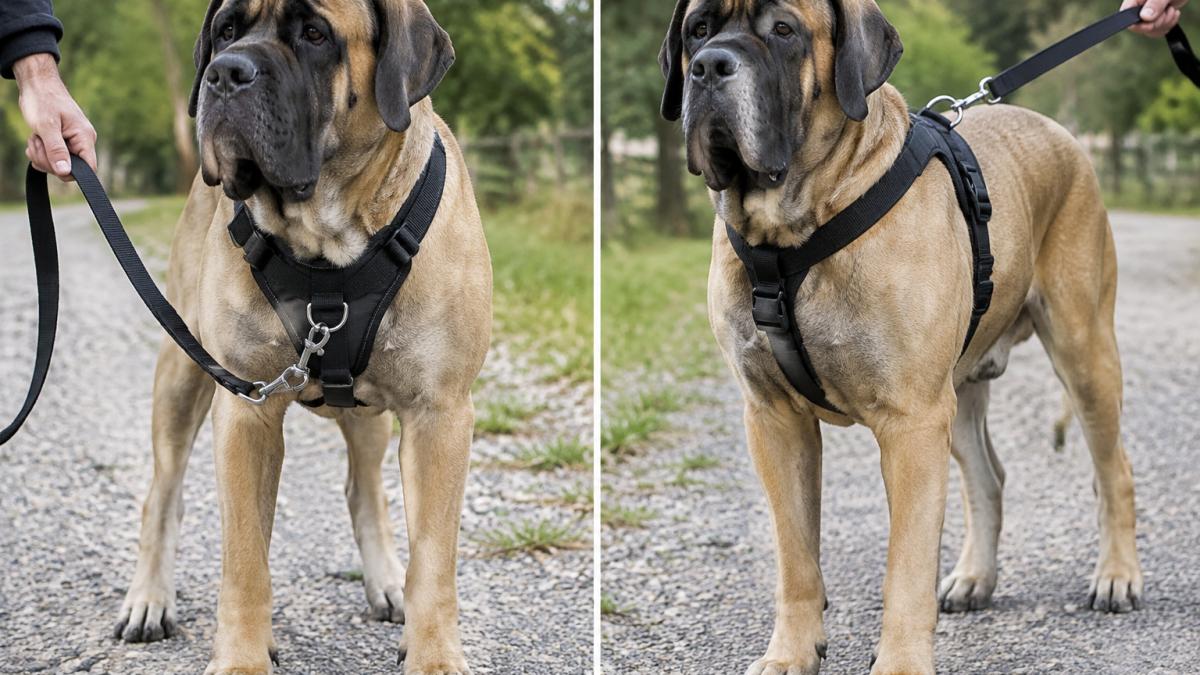
A front clip turns leash pressure sideways, redirecting a pulling mastiff's momentum instead of fighting it head-on. A back clip sits between the shoulder blades and gives a trained dog a comfortable, low-interference walk.
A 2025 review found that for dogs that pull, non-tightening front-clip harnesses appear to balance discomfort against pulling prevention (Cavalli et al. review of collars, harnesses, and head collars).
Front chest clip. The leash attaches at the center of the chest.
Back clip. The leash attaches between the shoulder blades. Nothing crosses the chest, so the gait stays natural and the dog can walk on a loose leash for miles.
Dual attachment points. Many mastiff-suitable harnesses offer both a front chest ring and a back ring. Clip to the front for training walks and crowded spaces, then switch to the back for relaxed neighborhood loops without buying a second harness. The trade-off is cost and complexity, more hardware means more to inspect, A direct comparison for mastiffs looks like this in practice:
- Powerful puller still in training: front chest clip, because steering beats strength.
- Calm, trained adult: back clip, because comfort and gait matter more than steering.
- Mixed situations or a dog that shifts between calm and reactive: dual attachment points, so you can change clips without changing gear.
- Growing puppy: a harness with both rings and generous adjustability, so the same harness works through several growth stages.
Most mastiffs use both at different stages, which is why dual attachment points are worth considering from the start.
Dog harness leash attachment points and the hardware that holds them
Dog harness leash attachment points are the reinforced rings or loops where the leash connects, and on a mastiff they are the highest-load part of the whole setup. A D-ring rated for a 40-pound dog is not a D-ring rated for a lunging 170-pound dog.
Load-bearing strength comes from three things working together.
- The D-ring: solid stainless steel resists bending and rust; welded or split rings can open under shock loads
- The stitching: reinforced stitching plus Chicago-style tacks spread load across the webbing instead of one seam
- The webbing: nylon webbing with real thickness resists stretching and fraying
A 2024 study on harness design and forelimb biomechanics in pet dogs found research on pet-dog harnesses is still limited compared with assistance-dog gear (Dowdeswell et al., harness design and forelimb biomechanics). Translation: check the hardware yourself rather than trusting a label.
The best dog harness for pullers and how to fit it to a mastiff
The best dog harness for pullers combines a front chest attachment with a body-wrapping design, so pressure spreads across the chest rather than the throat.
Fitting is where most owners lose control, and mastiffs are harder to fit than the average large dog: the chest is deep and broad, the neck is thick, and the tuck behind the ribs is often shallow.
Measure in this order, with the dog standing on a level surface:
- Chest girth: wrap the tape around the widest part of the ribcage, just behind the front legs and over the deepest part of the chest. This number decides the size, not the neck measurement.
- Neck circumference: measure the base of the neck where a collar would sit. On a mastiff this is often close to the chest girth, which is why some harnesses that fit the chest are too tight at the neck.
- Chest depth: measure from the top of the back, just behind the withers, straight down to the bottom of the chest. Deep-chested dogs need a long enough chest panel; a short panel rides up toward the throat.
- Body length: measure from the base of the neck to the base of the tail along the spine. This confirms the back panel will sit flat rather than bunching behind the shoulders.
Then adjust and check fit in this order:
- Tighten the chest strap so you can fit two fingers, no more. On a mastiff, loose is the most common fitting error.
- Adjust the shoulder straps so the front ring sits at the center of the chest, not off to one side.
- Check the back panel sits flat between the shoulder blades and does not lift when the dog lowers its head.
- Slide a hand under every strap. If a strap digs in at the armpit or crosses the point of the shoulder, it will rub on long walks.
- Test with a short walk and re-check every strap after five minutes; a strap that looked snug in the driveway can loosen on the move.
Watch out: a harness that fits the chest but pinches at the neck is the most common mastiff fit failure, and it usually shows up as reluctance to walk or a dog that pulls harder to get away from the pressure.
For a mastiff puppy, re-measure monthly. Once the harness is set, our guide on how to stop dog pulling on leash walks you through the training plan step by step.
Pairing a heavy-duty leash for large dogs with the right clip
A heavy-duty leash for large dogs should match the clip it connects to in both strength and hardware type. The strongest harness ring in the world is only as good as the clip on the other end.
Dana R. in Boise walks Atlas, a 150-pound Great Dane, and asked whether our webbing and hardware hold up when he lunges. Our 6 ft giant breed leash is built from the same military-grade webbing as our collars. For the full range with hardware specs, browse our heavy-duty dog leashes.
Three compatibility checks before you clip on:
- Clip type: a metal snap clip with a locking gate beats a cheap trigger clip on a strong dog
- Clip size: the clip must fit around the D-ring without binding, so it seats fully closed
- Weather: stainless hardware and waterproof webbing matter if you walk in rain, mud, or snow
A common mistake is pairing a heavy harness with a thin fashion leash. The leash takes the full shock load, so it needs the same strength standard.
Choosing your Colossal Canine Co. setup for a 100-pound-plus dog
Choosing the right setup comes down to three decisions: clip position, hardware strength, and adjustability for your dog's size and temperament. Here is how we would build it.
| Your mastiff | Clip position | Why |
|---|---|---|
| Pulls hard, still training | Front chest clip | Steering control with less use |
| Walks politely, well trained | Back clip | Comfortable, low-interference walk |
| Mixed use, changing situations | Dual attachment points | Switch clips without changing gear |
| Growing puppy | Adjustable harness | Re-fits as the dog grows |
Every Colossal Canine Co. collar and leash is handmade to order from military-grade webbing and solid stainless steel hardware, built for dogs over 100 pounds. Our gear carries a lifetime guarantee.
If you want to know whether 304 or 316 stainless hardware holds up better on a heavy dog, our stainless steel comparison breaks down the difference. And when you are ready to build the full setup, compare our collar and leash bundles to match your harness choice.
The challenge is simple: most harness failures on mastiffs come from hardware and stitching, not from the harness style.
Frequently Asked Questions
Should a mastiff harness have a front or back leash attachment?
It depends on what you need the walk to do. A front chest attachment gives you steering control and is the usual pick for a mastiff that pulls, because pressure redirects the dog sideways rather than forward. A back clip suits a dog that already walks calmly and is used for everyday walking and tracking. Many owners end up with a harness that has both, then switch clips depending on the route.
Are front-clip harnesses better for mastiffs that pull?
For a mastiff, the front clip also keeps load off the neck. It is a management tool, not a fix on its own, so pair it with reward-based training and a harness sized for a giant breed.
Is a back-clip harness safe for a strong mastiff?
It can be, provided the harness fits securely and the hardware is rated for the load. The risk with a back clip on a strong dog is that pulling load lands on the shoulders and the dog can lean into it. Use a back clip for a calm walker, not as a brake.
What leash and harness hardware is strong enough for a mastiff?
Look for solid stainless steel D-rings and clips rather than stamped or plastic parts, reinforced stitching at every load point, and wide nylon webbing that spreads pressure across the chest. Check the attachment ring and stitching monthly for fraying or bending, and replace anything that shows wear. Colossal Canine Co. builds collars and leashes for dogs over 100 pounds with military-grade webbing and solid stainless steel hardware, so the leash clip matches the load the harness ring is built to take.
