how-to · November 23, 2026
7 Steps to Walk Two Large Dogs With One Handler
13 min read · Editorial Team
Last Updated: November 22, 2026
Quick Summary
To walk two large dogs with one handler, first build calm solo walks and loose-leash manners in each dog, then use separate six-foot leashes held one per hand with the dogs on opposite sides. Keep leashes low at hip height, stop walking when a leash stays tight for more than five seconds, and skip pair walks if either dog is reactive or injured.
- Give each dog ten to fifteen minutes of solo walking practice before attempting pair walks.
- Stop walking whenever the leash stays tight for more than five seconds.
- Two 110-pound dogs put 220 pounds of potential pull on your arms and back.
- Six feet is the working leash length for control on a normal walk.
- Start pair walks at ten to fifteen minutes and add five minutes per week.
Table of Contents
- Why One Handler and Two Large Dogs Needs a Plan
- Step 1: Build Calm Solo Walks Before Walking Together
- Step 2: Teach Loose-Leash Manners and Heel Position
- Step 3: Choose Your Walking Position and Equipment Setup
- How to Walk Two Dogs Without Getting Tangled
- The Best Leash for Walking Two Dogs: Coupler vs. Separate Leashes
- Walking Two Dogs at Once: Leash Length, Pace, and Duration
- When Not to Walk Both Dogs Alone
- Frequently Asked Questions
Why One Handler and Two Large Dogs Needs a Plan
To walk two large dogs with one handler is a skill, not a gamble. The American Kennel Club's guidance on walking multiple dogs at once treats two-dog handling as something you build toward, not something you improvise on a Monday morning. At Colossal Canine Co., we build gear for dogs over 100 pounds, and we've learned that the leash is only half the system.
Here's the core problem. Two dogs over 100 pounds each means over 200 pounds of animal on the end of your arms. A single lunge from a Great Dane can pull you off balance. Two lunges at once can put you on the ground.
So the goal is simple: keep both dogs calm, keep them separated, and keep your feet under you. Below, we'll show you exactly how to build that system in seven steps, starting with solo walks and ending with a tangle-free routine.
But first, here's what most guides get wrong. They teach leash skills and skip handler safety. For giant breeds, those are the same subject.
Step 1: Build Calm Solo Walks Before Walking Together
Each dog needs to walk well alone before you ask for two. That means no pulling, no lunging, and attention to the handler on a normal route.
Start with short walks, one dog at a time. Ten to fifteen minutes is plenty. Pick a quiet route and repeat it until the dog settles into a walking pace without constant correction.
Watch for these readiness signs:
- The dog walks on a loose leash for most of the route
- The dog checks in with you without being asked
- The dog recovers from a distraction within a few seconds
- The dog stays calm when another dog passes at a distance
A common mistake is rushing this stage. Owners walk each dog once or twice, see decent behavior, and jump to pair walks. Then the first squirrel shows up and both dogs react at once.
Step 2: Teach Loose-Leash Manners and Heel Position
Loose-leash walking means the leash hangs slack while the dog stays near you. Heel position means the dog walks at your side, not out front.
The training method is simple. Reward the dog for staying close. Stop moving when the leash goes tight. Wait for the dog to come back to you, then start again.
Practice in a low-distraction area first. Your yard or a quiet street works. Add distractions only after the dog holds heel position reliably in calm settings.
For a full step-by-step plan to fix pulling, see our guide on how to stop dog pulling on leash.
The 5-Second Rule for Loose-Leash Walking
Here's the rule we teach: if the leash stays tight for more than five seconds, stop walking. Plant your feet and wait. The dog learns that forward motion only happens on a slack leash. Five seconds is long enough to notice and short enough to keep the lesson clear. Repeat this on every walk until it becomes automatic.
Step 3: Choose Your Walking Position and Equipment Setup
Before you clip anything on, decide two things: whether one handler can physically manage the pair, and where each dog will walk. With two large dogs, these are safety decisions, not preferences.
Assess combined strength before your first pair walk
Add the two dogs' weights together. Two 110-pound dogs put 220 pounds of potential pull on your arms, shoulders, and lower back. Keep in mind that a sudden pull from a large dog can exceed what you can comfortably hold.
Run a simple test on a quiet street with one dog at a time. Stand with feet shoulder-width apart, knees soft, and the leash held low near your hip. Have a helper create a mild, controlled pull from the side. If you can hold your stance without stepping, you have a baseline.
Choose a stable stance and hand position
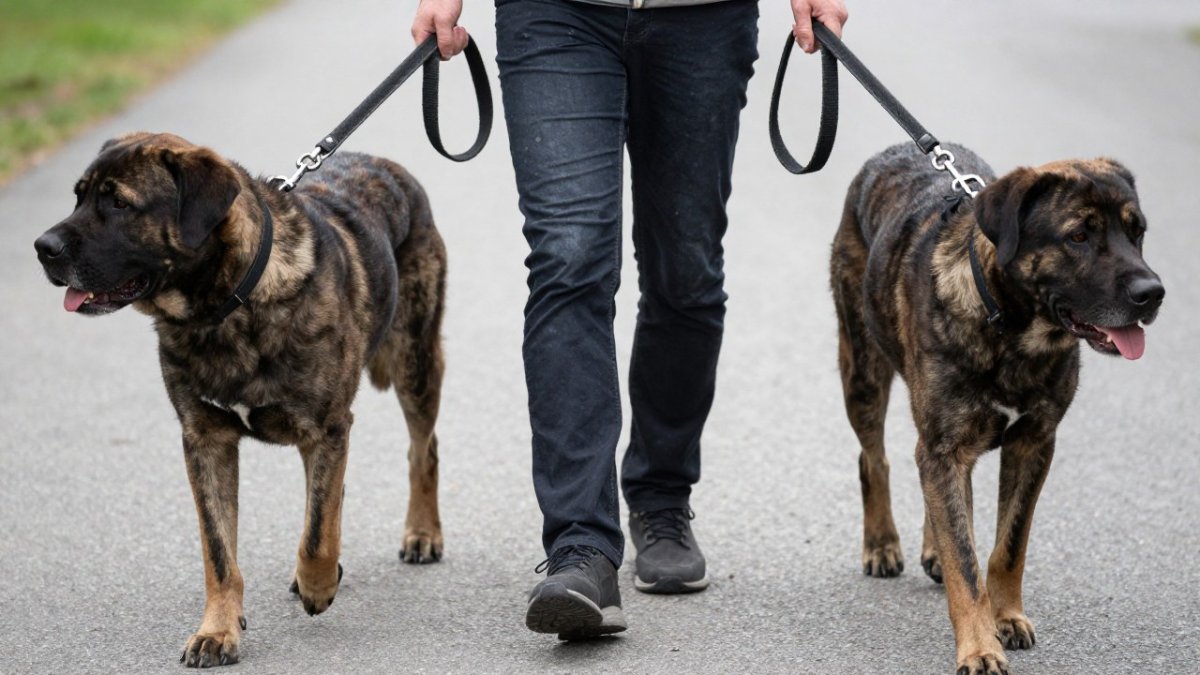
Stand with one foot slightly forward and your weight centered, not locked. Keep leashes low, around hip height, rather than at chest height where a lunge can rotate your shoulders. Hold one leash per hand with a relaxed grip and a thumb over the top of the handle. Keep your elbows close to your body so a sudden pull travels into your core instead of yanking your arm out to the side.
Watch out: wrapping a leash around your wrist or hand is a common habit that turns a strong pull into a wrist or finger injury; keep the loop over your palm and your thumb outside the handle.
Pick a walking position for each dog
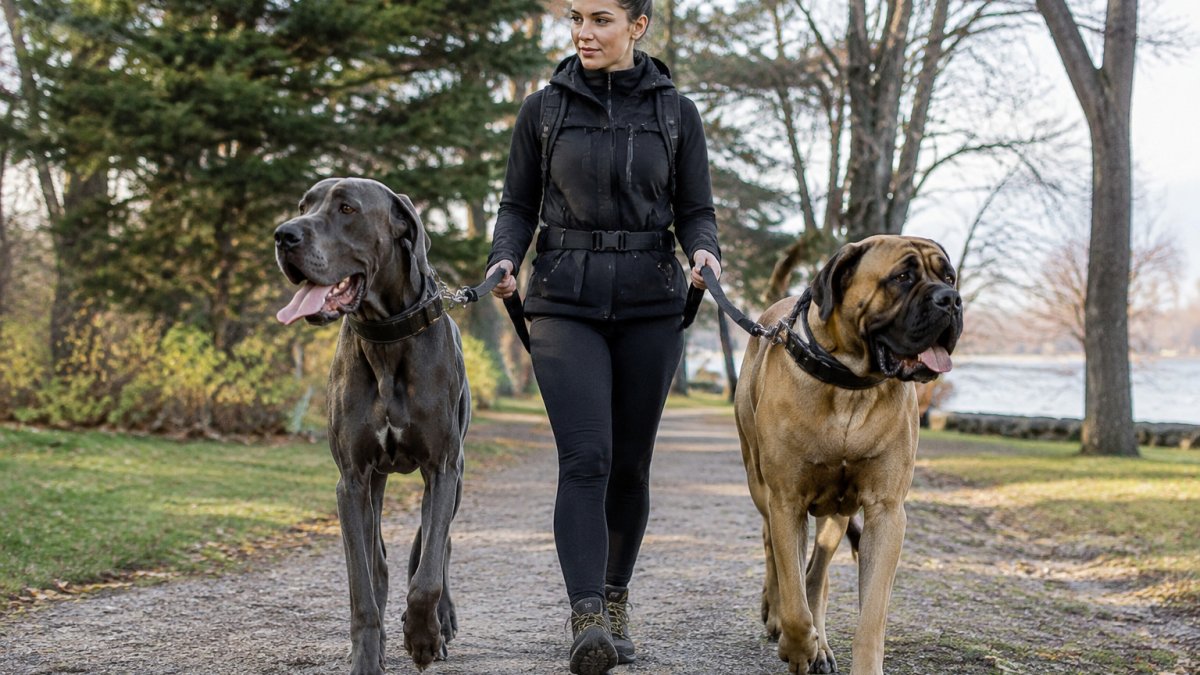
One dog on each side, left and right, is the default for large pairs because it keeps the dogs apart and gives you a clear center lane. Both dogs on the same side works only for calm pairs with matched pace, and it invites tangling when one dog drifts.
Match equipment to the job
You need independent control of two large animals. That means separate leashes, sturdy hardware, and a properly fitted collar or harness on each dog. A six-foot leash is the working standard: enough slack for normal walking, short enough to reel in before a dog builds momentum.
This is where gear quality stops being a preference. Standard leashes and thin hardware can fail under the sudden load of a 150-pound dog. Our 6 ft giant breed leash is built with military-grade webbing and solid stainless steel hardware, made for dogs over 100 pounds.
How to Walk Two Dogs Without Getting Tangled
The short answer: keep the dogs on separate leashes, hold one in each hand, and keep a gap between them. Tangles happen when both dogs drift to the same side, when one leash wraps behind your legs, or when a dog crosses in front of you to reach something interesting.
These habits prevent most of it:
- Hold one leash per hand and keep your arms relaxed at your sides
- Keep the dogs on opposite sides, even when they want to drift together
- Shorten the leash before you pass a distraction, not after
- Turn your body away from the tangle instead of pulling the leashes apart
- Practice a "switch" cue so the dogs learn to swap sides on command
Leash slippage makes tangles worse. If your grip slides, you lose the spacing you set up. Our guide on how to stop a strong dog leash from slipping covers grip and hardware fixes for heavy dogs.
Troubleshooting Tangles and Sudden Reactions
When a tangle happens, stop moving. Pulling two leashes apart while both dogs are moving tightens the knot. Instead, shorten both leashes, guide the dogs back to their sides, and reset before you walk on.
Sudden reactions need a different response. If one dog lunges, brace your feet, keep the leash low, and turn the dog away from the trigger.
Reactivity is the wildcard here. A dog that reacts to other dogs, bikes, or runners needs solo work on that trigger before it can handle a pair walk. Walking two dogs together does not fix reactivity. It hides it until something goes wrong.
The Best Leash for Walking Two Dogs: Coupler vs. Separate Leashes
There is no single best leash for two large dogs. The right setup depends on whether you need independent control, how matched the dogs are, and how quickly you can shorten a leash under load. Here is a practical decision guide, plus what to do when the walk goes wrong.
Compare the four common setups
| Setup | Control | Best For | Watch Out For |
|---|---|---|---|
| Separate leashes, one per hand | High, independent control | Large dogs, reactive dogs, uneven pairs | More coordination at first |
| Leash coupler | Low, shared control | Two calm small dogs with matched pace | One lunge pulls both dogs and your wrist |
| Two leashes, one handle | Medium | Short calm walks | Limited spacing between dogs |
| Long line plus short leash | Mixed | Training one dog while managing the other | Tangles if the long line goes slack |
For giant breeds, separate leashes with heavy hardware are the safer default. A coupler joins both dogs to one handle, which sounds convenient but removes your ability to control each dog on its own. If one dog lunges, the coupler transfers that force to the other dog and to your wrist.
Leash length should match the job. Six feet is the working standard for control on a normal walk. Our 10 ft giant breed leash gives you room to manage spacing when one dog needs more slack than the other; pair it with a shorter leash on the calmer dog and you have a setup that adapts as the walk changes.
Troubleshoot tangles step by step
When a tangle happens, stop moving. Pulling two leashes apart while both dogs are moving tightens the knot. Instead, shorten both leashes, guide the dogs back to their sides one at a time, and reset before you walk on. If a leash wraps behind your legs, turn your body away from the tangle rather than stepping over it. Practice a "switch" cue so the dogs learn to swap sides on command, which prevents most crossings before they start.
Handle sudden reactions without losing the other dog
If one dog lunges, brace your feet, keep that leash low, and turn the lunging dog away from the trigger. Do not yell at the other dog, because it did nothing wrong and will start to expect stress on every walk.
Reactivity is the wildcard here. A dog that reacts to other dogs, bikes, or runners needs solo work on that trigger before it can handle a pair walk. Walking two dogs together does not fix reactivity. It hides it until something goes wrong. If either dog has a bite history or severe fear, use a second handler or work with a qualified trainer before attempting pair walks.
Walking Two Dogs at Once: Leash Length, Pace, and Duration
Leash length should match the job. Six feet is the working standard for control on a normal walk. Ten feet helps when you need spacing, but only if you can reel it in fast.
Pace is the next lever. Walk at the speed of the slower dog, not the faster one. A steady, calm pace keeps both dogs in heel position and reduces pulling.
Duration should build gradually. Start with ten to fifteen minutes of pair walking, then add five minutes per week as both dogs stay calm. Short walks that end on a good note beat long walks that end in a tangle.
When Not to Walk Both Dogs Alone
Some situations call for a second handler, or no walk at all. Skip the pair walk when:
- One dog is injured, recovering, or on restricted activity
- Either dog is in the middle of reactivity training
- You are walking in a crowded area with tight space
- Weather or footing makes a fall likely
- One dog is much stronger or faster than the other right now
There's no shame in walking dogs separately. Many owners of giant breeds do it permanently, and it's the safer choice for dogs with different energy levels or different training needs. A second handler also solves the problem cleanly when you have one available.
Two large dogs on one leash system is a real test of both your gear and your routine. If you're tired of flimsy hardware and leashes that stretch under load, Colossal Canine Co. builds gear for dogs over 100 pounds, with military-grade webbing, solid stainless steel hardware, and a lifetime guarantee. Our collars and leashes are handmade to order and sized for giant breeds.
Frequently Asked Questions
What is the best way to walk two large dogs at the same time?
Train each dog to walk calmly on a loose leash before pairing them. Then use two separate heavy-duty leashes, one dog on each side of your body, and start in a low-distraction area like your yard. Keep sessions to 10-15 minutes at first and add duration only when both dogs stay calm. Large dogs over 100 pounds need hardware rated for that load, so check webbing and clips before every walk.
Is a leash coupler safe for walking two large dogs?
A coupler can work for two calm dogs of similar size, but it gives you less independent control. If one large dog lunges, the coupler pulls the other dog sideways and can tangle both. For dogs over 100 pounds, separate leashes usually give better handler control and let you manage each dog's position. Test any coupler with both dogs in a fenced yard before using it on a sidewalk.
How do you walk two dogs without their leashes getting tangled?
Hold one leash in each hand and keep each dog on an opposite side of your body. Keep leashes short enough that neither dog can cross in front of you. If a tangle starts, stop walking, shorten both leashes, and untangle before moving again. Practicing turns and pace changes in a low-distraction area teaches both dogs to stay in their lane before you try a busy street.
Should you train two dogs to walk together or separately first?
Separately first. Each dog needs reliable loose-leash skills on its own before you add the distraction of another dog. Walking dogs separately also lets you match each dog's pace and training level. Once both walk calmly alone, introduce short parallel walks with a second handler if possible, then progress to one handler. This staged approach prevents one dog's bad habits from spreading to the other.
